
UK Horse Racing Trainers: Strike Rates, Records, and Analysis
 Available in US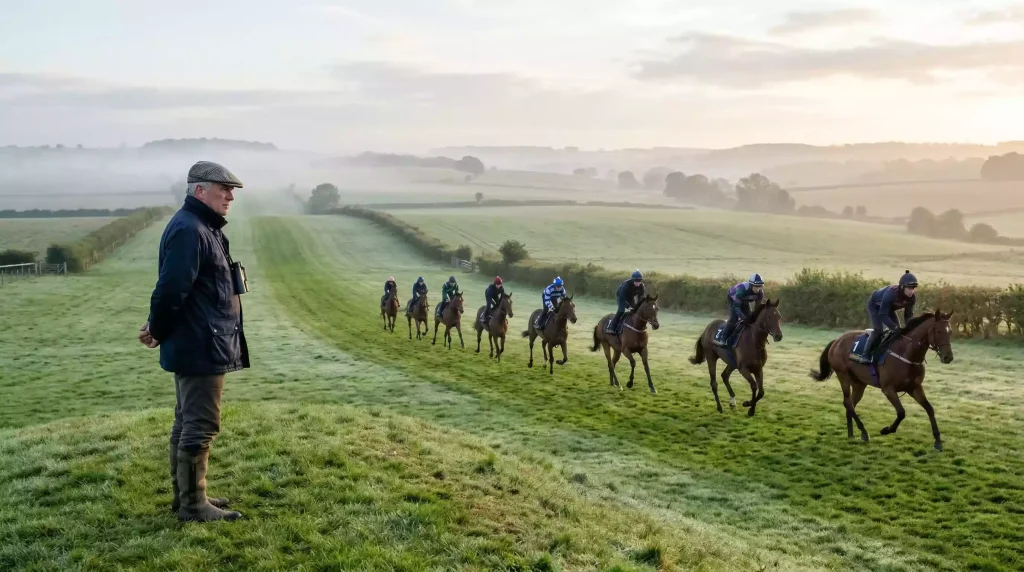
The trainer is the architect. They select the race, determine the fitness programme, decide the equipment, and — critically — choose the ground conditions on which their horse will compete. Which UK trainer has the best strike rate depends on how you measure it: by volume, by conversion rate, by prize money, or by performance at the highest level. Each metric tells a different story, and a serious form student looks at all of them before crediting any single number.
The horse population in British racing continues to contract. According to the BHA’s 2025 Racing Report, horses in training fell to 21,728 — a 2.3% decline from the previous year, extending a steady downward trend since 2022. That shrinking pool concentrates quality among the larger, better-resourced yards, making trainer selection a more significant variable than ever in assessing any given runner.
UK Horse Racing Trainers — More on this topic at horse race winner.
Leading Flat Trainers
On the flat, a small group of trainers dominate British racing by every meaningful measure. John and Thady Gosden’s Newmarket operation is the standard-bearer for classic-generation horses, with a record at the highest level — Group 1 races, Classics, and Royal Ascot — that few contemporary yards can match. Their strike rate typically sits around 20-22% across all runners, but it climbs above 30% when filtered for horses rated 100 or above. This is typical of elite flat operations: the strike rate across the full book of runners is diluted by maidens and lesser-quality horses in development, while the top-end performers convert at a much higher rate.
Aidan O’Brien, based at Ballydoyle in Ireland but a dominant force in British Group racing, runs fewer horses in Britain than the domestic yards but at a consistently higher level. His British strike rate can appear modest by volume because many of his runners are aimed at the most competitive races in the calendar — Group 1 events where the opposition is fiercest. Judging O’Brien’s record by raw percentage misses the point: his winners list reads like a history of the sport’s greatest races.
Charlie Appleby, training for Godolphin out of Moulton Paddocks in Newmarket, has emerged as one of the most consistent producers of top-class flat horses in Britain. Appleby’s strike rate has hovered around 25% in recent seasons — high by any standard, and underpinned by the extraordinary resources of the Godolphin operation, which gives him access to some of the best-bred horses in training. His record at the Dubai World Cup carnival and in European Group 1s reflects a yard operating at peak efficiency.
Among the volume trainers — those running large strings of horses across lower-class races — Richard Fahey, Karl Burke, and William Haggas consistently feature near the top of the trainers’ championship by winners. Haggas, in particular, combines volume with quality: his strike rate across all runners typically exceeds 20%, and his runners at the higher classes convert at well above 30%. For bettors, Haggas-trained runners in handicaps offer a reliable starting point because the yard’s rate of placing horses at the right level is demonstrably strong.
Leading National Hunt Trainers
Jump training is dominated by an even smaller elite. Paul Nicholls, based at Ditcheat in Somerset, has been champion trainer more times than any other jump trainer in the modern era. His strike rate is typically around 18-20% — lower than the top flat yards because National Hunt racing inherently produces more non-completions (falls, unseated riders, pulled up). But his Grade 1 record is extraordinary, with Gold Cup, King George, and Champion Hurdle winners across decades. Nicholls’ yard is especially strong at the Christmas meetings and at Cheltenham, where his record is rivalled only by the Irish raiders.
Willie Mullins, like O’Brien on the flat, is the Irish colossus of jump racing whose presence at British festivals — particularly Cheltenham — reshapes the market. Mullins has dominated the Cheltenham Festival in recent years, sending over raiders that routinely outperform their British-trained rivals. His British strike rate reflects the fact that he targets only the best races, and his conversion rate at Cheltenham is the highest of any trainer at the meeting.
Nicky Henderson, based at Seven Barrows in Lambourn, is the doyen of British jump racing. His record at the Cheltenham Festival is second only to Mullins, and his handling of Champion Hurdle and Champion Chase horses is widely regarded as the best in the sport. Henderson’s strike rate has dipped in recent seasons as the horse population contracts and competition from the Irish yards intensifies, but his ability to produce a horse at peak fitness for a target race remains unmatched among British trainers.
Dan Skelton and Olly Murphy represent the rising generation of NH trainers. Skelton, training a large string from Warwickshire, wins races by volume and has consistently been among the top five trainers by number of winners. Murphy, with a smaller operation but a growing reputation for big-race horses, has shown that a high strike rate from a medium-sized yard can compete with the established names.
Course Specialists
Some trainers dramatically outperform their overall strike rate at specific courses. This is not random. Trainers tend to target tracks that suit their horses’ profiles, are within reasonable travel distance of their yards, and whose race programmes align with the class of horse they train.
A Yorkshire-based trainer like Tim Easterby will have a significantly higher strike rate at northern tracks — Catterick, Thirsk, Ripon, Redcar — than at southern venues. The horses are trained in similar conditions, the travel is shorter, and the trainer’s understanding of the track’s quirks is deeper. Similarly, a Lambourn trainer may consistently outperform at Newbury, which is the nearest course and effectively a home venue.
Bettors can exploit these patterns. When a trainer has a 30% strike rate at a particular course against a career average of 18%, that gap is meaningful — it suggests a systematic advantage in placing horses at that venue. Cross-referencing trainer-course strike rates with horse form and going preferences is one of the more reliable compound filters available in race analysis.
Trainer Form in Practice
A trainer’s overall season record is useful for context, but current form — their results in the last fourteen to twenty-eight days — is more predictive for betting purposes. Yards go through hot and cold spells driven by the health of their string, the ground conditions, and the cluster of targets in the racing calendar. A yard that has sent out eight winners from its last twenty runners is in a different mode from one that has managed two from thirty.
The BHA’s data shows that the total number of horses making at least one start fell from 18,630 in 2023 to 18,452 in 2024, with flat runners up 0.5% and jump runners down 3%. That decline in jump horses intensifies competition for runners at every level, which means trainers with the healthiest, most active strings have a built-in edge simply by having horses available to run. In National Hunt racing in particular, checking whether a trainer’s yard is in full operation — no widespread illness, no ground-related layoffs — is a practical step that many bettors skip.
Trainer-jockey partnerships are the final data point worth tracking. Stable jockeys — riders retained by a particular yard — tend to know their trainer’s horses intimately: their quirks, their preferences, their ideal race plans. When a retained jockey rides a horse for the first time, they arrive with intelligence that a freelance booking cannot replicate. Conversely, when a trainer jocks off their stable rider in favour of a high-profile alternative, it is often a signal of genuine ambition for that race — an intention to maximise the horse’s chance with the best available rider.
Using Trainer Data Without Overweighting It
Trainer statistics are a filter, not a verdict. A 25% strike rate tells you the yard is well-run. It does not tell you whether this specific horse, in this specific race, on this specific ground, is a good bet. The trainer’s record narrows the field — it separates the professional operations from the rest — but the final assessment must still account for form, class, going, and price. Trainers create the conditions for winners. The race itself decides.
See also Grand National Winners.
