
Grand National Winners: History, Records, and Key Facts
 Available in US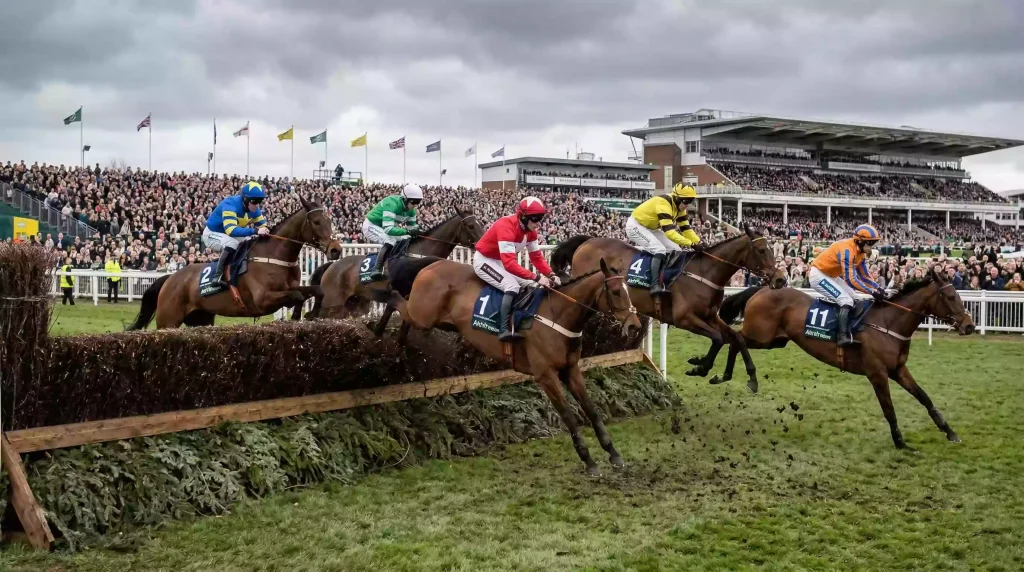
The Grand National is the race that non-racing people know by name. Run at Aintree every April over four miles and two and a half furlongs, it is the longest, most demanding, and most publicly scrutinised steeplechase in the world. Its list of Grand National winners reads like a history of the sport itself — from Victorian legends to modern controversies, from 100/1 shocks to dominant champions carrying top weight to victory. No other race in British racing carries this combination of distance, difficulty, spectacle, and public attention.
But the Grand National is also a race that has been forced to evolve. The same dangers that create its drama have driven decades of safety reform, and the race run in 2026 is a fundamentally different challenge from the one contested even twenty years ago. Understanding that evolution — the history, the records, and the reforms — is essential context for anyone who watches, follows, or bets on the race.
Grand National Winners — More on this topic at horse race winner.
A Timeline of the Grand National
The first officially recognised Grand National was run in 1839, though races over the Aintree course date to 1836. The early decades were raw — large fields, minimal veterinary oversight, and fences built to test horse and rider to the limit. Lottery, the first winner, set the template: a bold jumper ridden by a brave jockey over terrain that punished hesitation.
The race survived two World Wars (it was suspended during both), and the twentieth century produced its most enduring narratives. Golden Miller won in 1934 while also holding the Cheltenham Gold Cup — the only horse to achieve both in the same season. Red Rum, trained on the sands of Southport beach by Ginger McCain, won three Nationals (1973, 1974, 1977) and finished second twice, becoming the most famous racehorse in British sporting history. His record of three victories has never been equalled.
The 1990s and 2000s brought both triumph and controversy. The 1993 race was declared void after two false starts, a debacle that led to major changes in starting procedures. Aldaniti’s victory in 1981, ridden by Bob Champion after the jockey’s recovery from cancer, became one of the great human-interest stories in sport. Tiger Roll, trained by Gordon Elliott in Ireland, won back-to-back Nationals in 2018 and 2019, the first horse to do so since Red Rum.
The pandemic cancelled the 2020 race entirely — the first cancellation since the Second World War. When the National returned in 2021, it did so with reduced crowds and heightened awareness of the welfare debate that had been building for years.
Records and Legends
Red Rum’s three victories stand alone at the top of the record books. No other horse has won more than twice. Mr Frisk holds the course record — 8 minutes 47.8 seconds in 1990, set on fast ground that the race now actively avoids by scheduling earlier in the day when conditions are typically softer.
The longest-priced winner in modern times is Mon Mome, who won at 100/1 in 2009. Caughoo (1947) and Foinavon (1967) are earlier 100/1 winners, though Foinavon’s victory came only because a mass pile-up at the 23rd fence — now named after him — eliminated or impeded virtually every other runner. It remains the most chaotic moment in Grand National history.
The race has been won from the front (Red Rum in 1977), from behind (Hedgehunter in 2005), by 12-year-olds, by former invalids, and by horses carrying top weight against all expectations. The National’s distance and the number of variables involved — thirty fences, fields of up to thirty-four, and a race duration exceeding nine minutes — make it the least predictable major event in the sport. That unpredictability is both its draw and its dilemma.
Safety Reforms: How the Race Has Changed
The Grand National has always attracted criticism over horse welfare. Deaths during the race — or as a direct consequence of injuries sustained in it — have driven waves of reform, each responding to specific incidents and broader shifts in public expectation.
Since 2013, the changes have been structural rather than cosmetic. The maximum field was reduced from 40 to 34 runners, limiting the density of the pack and the risk of fallers bringing down other horses. The first fence was repositioned further from the start to reduce approach speed. A standing start replaced the traditional flag, giving the starter better control. And the race itself was moved earlier in the day’s programme to ensure the ground is at its safest — before a full card of preceding races can churn up the surface.
The most recent intervention is the transition to padded hurdles at Aintree’s hurdle races, though the National itself is a steeplechase and its fences remain birch-built. However, across all of British jump racing, the data behind these reforms is increasingly robust. According to the BHA’s Horse PWR welfare portal, the overall fatality rate across flat and jump racing in 2025 was 0.22% of all runners — 192 horses from 86,300 starts. In jump racing specifically, 0.47%. These numbers are not zero, and the sport does not pretend otherwise. But they are falling, and the trajectory matters.
Modelling by the Royal Veterinary College, using fourteen years of race data, has shown that One-Fit Padded Hurdles reduce the risk of horses falling by 11%. All British racecourses are committed to completing the transition from birch to padded hurdles by October 2026. As Professor Kristien Verheyen of the RVC has stated: “This research will greatly help the industry in making scientifically backed decisions that will benefit the welfare of the sport’s equine participants, which must be the number one priority of all involved in racing.”
The Modern Grand National
The race that runners face today is designed to be survivable, not soft. The fences remain formidable — Becher’s Brook still has its landing-side drop, The Chair still stands taller than any other fence on the course, and the Canal Turn still demands precision at speed. But the sport’s tolerance for preventable harm has shifted, and the data now exists to distinguish between inherent risk and avoidable risk.
Data from the BHA confirms that 38% of all fatalities in jump racing are associated with a fall. The Grand National’s reforms — reducing field sizes, modifying fence approaches, managing ground conditions — are all targeted at reducing falls specifically, because falls are the single most significant precursor to the worst outcomes.
For bettors, the modern National presents its own challenges. Smaller fields (though still large by any standard) and safer fences have slightly increased the influence of form and class relative to pure luck and survival. Tiger Roll’s back-to-back wins would have been harder to predict in the chaotic Nationals of the 1960s. The reform era has not made the race predictable — favourites still lose more often than they win — but it has made it marginally more analysable.
More Than a Race
The Grand National is a cultural event, a welfare flashpoint, a betting phenomenon, and a sporting contest simultaneously. Its winners carry a weight of public meaning that no other horse race matches. Understanding the history — who won, how the race was run, and how it has been reshaped by data, scrutiny, and reform — is the foundation for engaging with the race as anything more than a once-a-year flutter.
See also Cheltenham Festival Guide.
