Cheltenham Festival Guide: Races, Winners, and How to Follow
 Available in US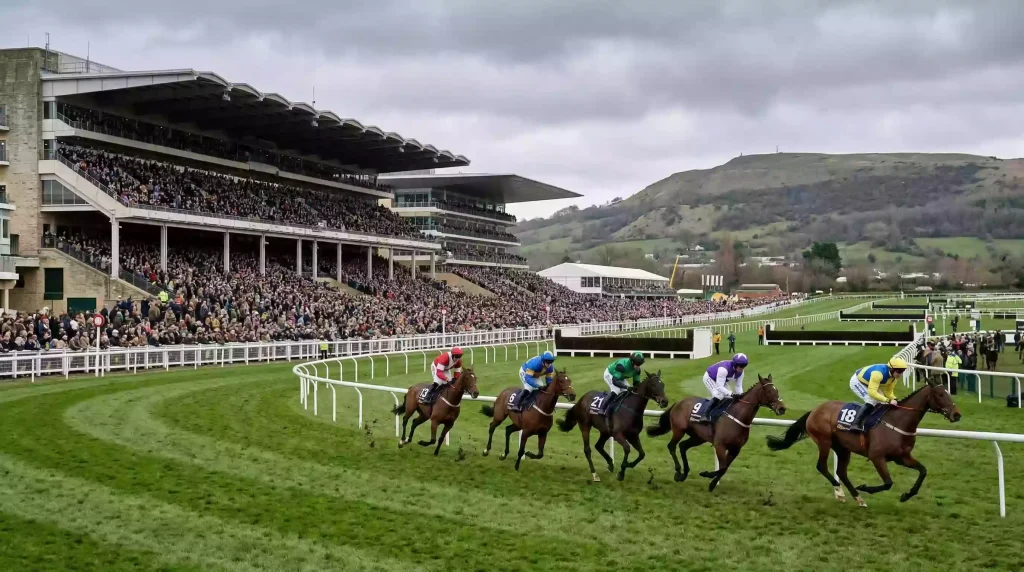
The Cheltenham Festival is the championship meeting of National Hunt racing. Four days in March, twenty-eight races, and the most concentrated block of elite jump racing on the calendar. Every major stable in Britain and Ireland targets Cheltenham, and for many trainers, the entire season is built around arriving here with their best horses in peak condition. A Cheltenham Festival guide is not a luxury — it is a map through the most complex, competitive, and form-defining week in the sport.
The Festival takes place at Prestbury Park in the Cotswolds, a left-handed, undulating course with a steep uphill finish that separates genuine class from surface-level form. Winning at Cheltenham requires stamina, jumping ability, and the constitution to handle an atmosphere that is more intense than anything else in jump racing.
Cheltenham Festival Guide — More on this topic at horse race winner.
Day by Day: The Race Programme
Each of the four days has its own character, its own championship race, and its own rhythms.
Day One — Champion Day — opens with the Supreme Novices’ Hurdle, the traditional Festival curtain-raiser and the first test of the Irish versus British dynamic that runs through the entire meeting. The feature race is the Champion Hurdle, the two-mile championship for the fastest hurdlers in training. The Arkle Trophy (novice chase, two miles) also features on the card, along with competitive handicaps including the Ultima and the Boodles Handicap Hurdle. Day One sets the tone: if one nation’s horses dominate the opener, the market recalibrates the rest of the week accordingly.
Day Two — Ladies Day — revolves around the Queen Mother Champion Chase, the two-mile steeplechase that rewards speed, accuracy, and bravery in equal measure. The Ballymore Novices’ Hurdle (two miles five furlongs) tests the next generation of staying hurdlers, and the Cross Country Chase provides a spectacle unlike anything else in racing — a course that weaves across both the Old and New tracks with banks, ditches, and obstacles that bear no resemblance to conventional fences.
Day Three — St Patrick’s Thursday — is the Stayers’ Hurdle day. The three-mile hurdle championship typically produces attritional races where stamina is the defining quality. The Ryanair Chase (two miles five furlongs, Grade 1) sits between the Champion Chase and the Gold Cup in distance, attracting fast-travelling chasers who lack the stamina for the Gold Cup but have more class than the average two-miler. The Pertemps Final and the Plate handicap fill out a card that often produces the biggest-priced winners of the week.
Day Four — Gold Cup Day — is the climax. The Cheltenham Gold Cup is the three-mile-two-furlong championship chase, the race that crowns the best staying chaser in training. It has produced some of the sport’s most memorable moments — Best Mate’s three consecutive victories (2002-2004), Kauto Star’s record-equalling wins (2007, 2009), Al Boum Photo’s back-to-back triumphs (2019-2020). The supporting card includes the Triumph Hurdle (four-year-olds, two miles), the Albert Bartlett (novice hurdle, three miles), and the Martin Pipe Conditional Jockeys’ Handicap Hurdle, which closes the Festival and often produces a dramatic last-race finish.
Across the four days, the programme covers every category of jump racing: novice and open, hurdle and chase, sprint and staying distances, championship and handicap. There is no gap in the schedule. Every slot is filled with a race that carries significance for form, breeding, or betting purposes.
Gold Cup History: The Race That Defines Champions
The Gold Cup has been run since 1924, though the Festival itself dates to 1911 in its current form. Golden Miller won five consecutive Gold Cups between 1932 and 1936 — a record that has never been approached. In the modern era, the race has become the defining contest of the National Hunt season, superseding even the Grand National in terms of form significance.
The Gold Cup is a conditions race — no handicap weights, no equalisation. The best horse wins, provided it stays the distance and handles the hill. Arkle (1964-1966), Desert Orchid (1989), and Kauto Star are among the names permanently associated with the race. Each brought a different quality: Arkle’s brilliance, Desert Orchid’s courage on ground he detested, Kauto Star’s ability to win, lose, and win again at the highest level.
Recent Gold Cups have been shaped by the Irish dominance of jump racing. Willie Mullins, Henry de Bromhead, and Gordon Elliott have between them trained the majority of Gold Cup runners — and winners — in the past decade. The concentration of quality in Irish yards has squeezed British trainers, and the BHA’s data showing a 9% decline in jump horses rated 130 or above underlines the structural challenge British racing faces in competing at this level.
Attendance and Atmosphere
The Cheltenham Festival draws crowds that rival any sporting event in Britain. The 2024 total attendance across the four days was a key contributor to the national figure of 4,799,730 racegoers who visited British racecourses that year. The atmosphere at Cheltenham is unique — the Prestbury Park amphitheatre, with the course set in a natural bowl, amplifies the crowd noise in a way that no other racecourse replicates.
The Festival’s economic impact on the local area is substantial, with Cheltenham and the wider Cotswolds region benefiting from tens of thousands of visitors spending on accommodation, dining, and transport over the four days. For many racegoers, Cheltenham is an annual pilgrimage — the same groups returning to the same bars, the same enclosures, the same arguments about which horse will win the Gold Cup.
Form Pointers: What Cheltenham Form Tells You
Cheltenham form is the gold standard in National Hunt analysis. A horse that runs well at the Festival — even if it does not win — has proved it can handle a unique combination of pressures: a stiff, undulating track; ground that ranges from good to heavy depending on the weather; deep, competitive fields; and an atmosphere that can unsettle inexperienced animals.
For this reason, form students treat Cheltenham lines with more weight than equivalent performances at flatter, less demanding tracks. A horse that finishes fourth in a Grade 1 at Cheltenham, beaten five lengths, may be rated higher in practice than one that wins a Grade 2 at Kempton by ten lengths. The context is everything.
However, the Festival’s intensity also produces misleading form. Horses that empty themselves on the final hill can return flat next time. Novices that overperform in the cauldron of a first Festival can regress once the adrenaline fades. And the ground — which can change dramatically between Tuesday and Friday — means that a form line from Champion Day may not be directly comparable to one from Gold Cup Day, even at the same distance. Reading Cheltenham form is not just about knowing who won. It is about understanding what the race took out of every horse in it.
The Week That Shapes the Season
Everything before the Cheltenham Festival is prologue. Everything after is epilogue or aftermath. The reputations made and broken in these four days set the narratives for the rest of the jump season, define the targets for Aintree and Punchestown, and provide the form lines that inform next year’s ante-post markets before the current season has even finished. There is no avoiding Cheltenham. The only question is how prepared you are when it arrives.
See also Royal Ascot Guide.
