
How Weather Affects UK Horse Racing: Abandonments, Going, and Results
 Available in US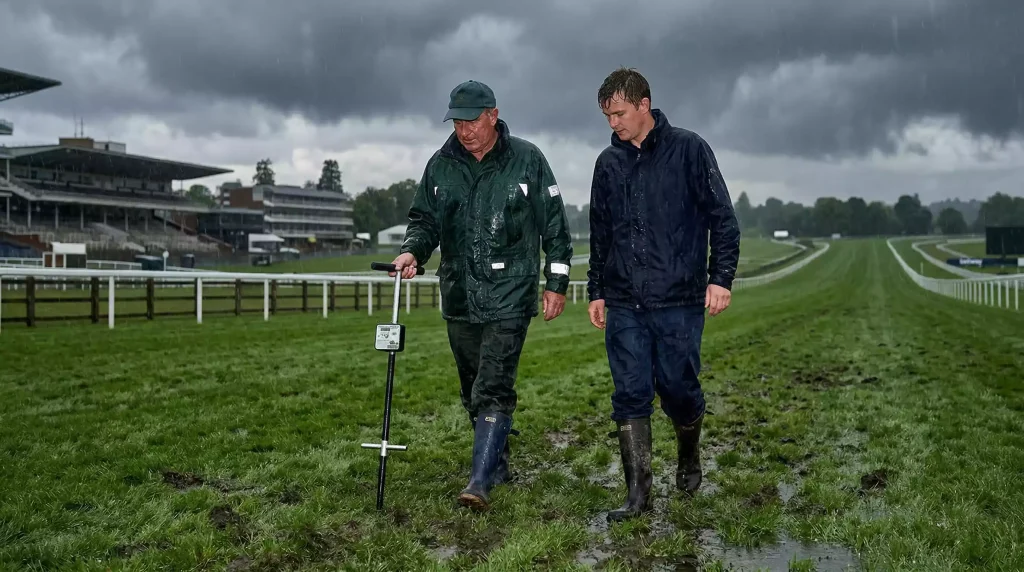
British weather does not just set the mood for a day at the races. It determines whether the races happen at all, what the ground will ride like when they do, and which horses are most likely to win. No other major sport is as directly governed by rainfall, temperature, and wind as horse racing. A forecast that shifts overnight can turn a competitive handicap into a one-horse race, cause a fixture to be abandoned before the first runner reaches the start, or transform a going description from good to heavy in the space of a few hours.
The BHA’s 2025 Racing Report acknowledged this dependency directly: “Changing weather patterns will mean that periods of more extreme conditions are likely to become the norm in the future and we’ll clearly need to adjust the way we do things to address this challenge.” That adjustment is already underway — in watering systems, drainage investment, fixture scheduling, and the way the sport reads and communicates going data. But the weather itself is not adjustable, and its influence on race outcomes is the single largest uncontrollable variable in the sport.
How Weather Affects UK Horse Racing — More on this topic at horse race winner.
Going and Rain: The Central Relationship
The going — the official description of the racing surface’s condition — is fundamentally a measure of how much water is in the ground. Rain softens turf. Absence of rain firms it. The clerk of the course monitors conditions using the GoingStick, a penetrometer that measures the ground’s resistance to force, and translates the readings into the official going description: firm, good to firm, good, good to soft, soft, or heavy.
The distribution is heavily skewed towards the middle of the scale. Analysis of UK turf races from 2016 to 2024 shows that 71-85% of races are run on some form of good ground (good to firm, good, or good to soft). Only 13-24% take place on soft or heavy going, and 3-9% on fast conditions (firm or harder). The seasonal pattern is predictable: the first quarter of the year (January-March) sees around 58% of races on soft or worse, while the third quarter (July-September) drops to 13%.
What matters for form analysis is not just the going description on race day but how quickly conditions have changed. A course that was good on Monday and is soft by Wednesday has experienced a rapid shift that catches trainers and bettors off guard. Ante-post markets priced on the assumption of good ground must reprice when rain arrives. Horses with a known preference for faster conditions are withdrawn, fields shrink, and the competitive landscape is reshuffled.
Prolonged dry spells create the opposite problem. Extended periods without rain push the going towards firm — a surface that produces faster times but is associated with a higher risk of concussive injury. Racecourses counter this with watering systems that can add moisture to the track in controlled amounts, and the clerk of the course has the authority to water to maintain the going within safe parameters. But watering can only do so much. In the drought-affected periods of 2024 and 2025, some courses faced weeks of firm ground that no amount of artificial irrigation could soften to a level that all trainers were comfortable with. Jump trainers, whose horses need at least good to soft ground to race safely over fences, pulled their animals from the track, and National Hunt field sizes dropped accordingly.
Abandonments: When Racing Cannot Happen
An abandoned fixture is not just an inconvenience for racegoers. It is a financial loss for the racecourse, a disruption for trainers who have prepared horses, and a gap in the betting product that bookmakers and broadcasters have already priced in. Abandonments are caused by waterlogging, frost, snow, extreme heat, and — occasionally — high winds that make conditions unsafe for horses and riders.
The BHA’s fixture list data shows that abandonments vary dramatically year-on-year based on weather patterns. In the final quarter of 2023, 59 fixtures were abandoned — a significant number driven by an exceptionally wet autumn. In the same period of 2024, only 13 were lost, largely because drier conditions prevailed. The percentage of Saturday race clashes — a related metric that measures how well the fixture list avoids scheduling conflicts — fell from 11.1% in 2022 to 5.8% in 2024, partly because fewer abandonments meant fewer rescheduled meetings creating unintended overlaps.
Frost inspections are a feature of winter jump racing. Before a fixture can proceed on frozen or near-frozen ground, the course is inspected early in the morning by the clerk and a BHA representative. If the ground is deemed too firm or icy to race safely, the fixture is abandoned — sometimes hours before the first race, after trainers and racegoers have already made the journey. Courses in northern and elevated locations (Catterick, Wetherby, Hexham) are more susceptible to frost than southern lowland tracks, which is why the winter jump programme is weighted towards circuits with milder microclimates.
Heatwaves and Frost: The Extremes
Extreme heat is a relatively new concern for British racing. When the Met Office issues a red weather warning for heat, racing does not take place. Below that threshold, courses can continue provided veterinary staff are present and additional welfare measures — cooling facilities, adjusted race schedules, and mandatory hydration protocols — are in place. The BHA’s welfare data shows no evidence of an increased fatality risk during hot weather periods, but the precautionary approach reflects both the sport’s duty of care and the public’s expectation that animal welfare comes before commercial scheduling.
Extended heatwaves in the summer of 2025 — April and May were the warmest and sunniest on record, and June was the warmest ever — produced prolonged periods of firm or faster ground. This was a net positive for flat racing attendance (warm weather draws racegoers), but a problem for the going: courses that could not water sufficiently saw fields shrink as trainers declined to run horses on ground they considered too fast. The irony of a heatwave is that it can simultaneously boost attendance and reduce the quality of the racing product.
Heavy snowfall is rare enough to be memorable when it occurs, but its effect is absolute: no racing can take place on snow-covered ground, and the recovery time after a thaw can add days to the disruption. Ice beneath the surface is particularly dangerous because it is invisible to inspection and can cause catastrophic slips at speed.
Weather as a Form Variable
For the form student, weather is not background noise. It is a filter that should be applied to every race assessment. A horse whose best form was achieved on good ground is a different proposition when the going turns soft. A trainer who has waited weeks for rain before entering a horse is signalling that the ground is central to their plan. A forecast of overnight rain before a major Saturday card is not just meteorological information — it is form information, because it will change which horses run, which are withdrawn, and how the race unfolds.
The weather cannot be predicted with certainty, but its effects can be anticipated. Knowing the seasonal patterns, the going distribution, and the specific vulnerabilities of each course to extreme conditions is part of the analytical framework that separates a serious form student from someone who checks the odds five minutes before the off.
See also Global Horse Racing Market.
