
Global Horse Racing Market: Where the UK Stands in 2026
 Available in US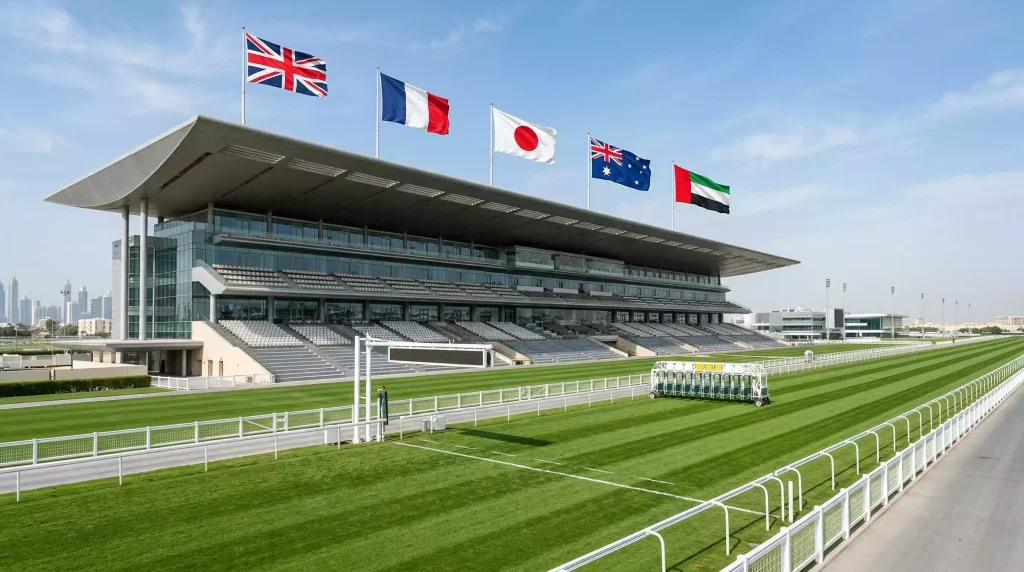
The global horse racing market was valued at approximately $400 million in 2024 and is projected to reach $665 million by 2034, growing at a compound annual rate of 5.2% according to Zion Market Research. That figure covers the racing industry itself — racecourse operations, media rights, prize money, breeding and sales — rather than the vastly larger wagering economy that orbits around it. The betting segment alone was estimated at $32 billion globally in 2024, with projections reaching $46 billion by 2031. These are not niche numbers. Horse racing remains one of the largest betting products in the world, even as its share of total gambling spend is challenged by football, basketball, and the relentless growth of online casino platforms.
Within this global market, the UK occupies a position that is simultaneously prestigious and precarious. British racing has the history, the brand, and some of the most iconic events in the sport. What it does not have is the financial model, the horse population trend, or the demographic trajectory that would allow complacency.
Global Horse Racing Market — More on this topic at horse race winner.
The Global Landscape
Horse racing is genuinely global in a way that few other sports can claim. Major racing jurisdictions include the United States, Japan, Australia, France, Ireland, Hong Kong, the UAE, and — increasingly — Saudi Arabia. Each operates under different regulatory frameworks, different funding models, and different relationships between racing and gambling.
Japan dominates by wagering volume. The Japan Racing Association operates a state-monopoly betting model that generates annual turnover exceeding $25 billion — dwarfing any other single jurisdiction. Japanese prize money is the highest in the world for domestic racing, and the country’s breeding industry has expanded to produce globally competitive bloodlines. The Japan Cup and the Arima Kinen are among the richest races on the planet, and Japanese-bred horses are increasingly competitive in European and Australian Group 1 events.
Australia is the second-largest racing market by race volume, with approximately 21,000 races annually and a deeply embedded racing culture. Australian prize money has grown significantly in recent decades, supported by a funding model where casino and gaming revenues in several states cross-subsidise the racing industry. The Melbourne Cup remains one of the best-known horse races globally, and the Australian breeding industry produces competitive bloodstock for both domestic and export markets.
France benefits from the Pari Mutuel Urbain (PMU), a state-backed pool betting operation that funds prize money at levels that British racing can only envy. French prize money for mid-tier races regularly exceeds the equivalent British figure by a factor of two or three, which creates a persistent incentive for owners and trainers to campaign their best horses in France rather than Britain. The Arc de Triomphe weekend at ParisLongchamp is Europe’s most valuable flat racing meeting, and the French breeding industry — supported by generous incentive schemes — has maintained a foal crop that is stable compared to the declining numbers in Britain and North America.
Hong Kong’s model is unique: a single racing body (the Hong Kong Jockey Club) controls all betting, racing, and prize money within the territory. The monopoly generates enormous revenue from a small but fanatically engaged betting population, producing per-race prize money levels that rival Japan’s. The UAE, led by Dubai and Saudi Arabia, has invested heavily in creating internationally significant race meetings — the Dubai World Cup and the Saudi Cup offer the largest single-race purses in the sport — though the domestic racing and breeding industries remain small compared to the established jurisdictions.
The UK’s Position: Prestige and Pressure
The UK’s contribution to the global racing economy is substantial. The industry generates £4.1 billion annually including induced effects, supports 85,000 jobs, and operates 59 racecourses hosting nearly 10,000 races a year. British bloodlines — particularly those from Newmarket and the surrounding studs — remain among the most commercially valuable in world racing. The Classics, Royal Ascot, and the Cheltenham Festival carry global prestige that no amount of prize money elsewhere can replicate.
But the structural pressures are real. Britain’s foal crop has fallen to 4,015 in 2025, continuing a multi-year decline. The number of horses in training dropped to 21,728. Betting turnover on British racing is falling year-on-year, and the sport’s dependency on a statutory levy — a funding mechanism that no other major jurisdiction replicates in exactly the same way — creates a single point of vulnerability that the industry has been lobbying to protect through the #AxeTheRacingTax campaign.
The comparison with Ireland is particularly pointed. Irish racing benefits from a direct government grant, lower operational costs, and a training infrastructure concentrated in a smaller geography. The result is that Ireland can offer competitive prize money with a smaller revenue base, and it has been systematically attracting — and retaining — quality horses that might otherwise race in Britain. The flow of talent from British stables to Irish campaigns is not new, but it has accelerated as the prize money differential has widened.
Shared Challenges Across Jurisdictions
Every major racing market faces a version of the same challenges. Foal crops are shrinking across the developed world — North America’s has fallen 28% over the past decade, and Australia’s has halved since its peak in 1989. The cost of breeding, raising, and training racehorses has risen faster than prize money in most jurisdictions, squeezing the breed-to-race sector that has historically provided the base of the horse population.
Public scrutiny of animal welfare is intensifying globally, driven by social media, investigative journalism, and shifting generational attitudes. Australia’s campaign against jumps racing, the UK’s ongoing debate over the Grand National, and the US response to fatal breakdowns at Santa Anita Park in 2019 are manifestations of the same underlying dynamic: the public expects higher welfare standards and is willing to withdraw its social licence from sports that do not meet them.
The betting landscape is also shifting. Competition from football, esports, and casino products — all of which offer more frequent, more accessible betting opportunities — is eroding horse racing’s share of the global wagering market. The jurisdictions that are best positioned are those with monopoly or near-monopoly betting models (Japan, France, Hong Kong) that capture wagering revenue directly. The UK’s fragmented, competitive bookmaker market generates lower per-race betting revenue than these monopoly systems, and the levy mechanism — however reformed — cannot fully close the gap.
A Sport of Nations
Horse racing is not a single global market. It is a collection of national and regional markets, each shaped by its own history, regulation, and economics. The UK’s position within that collection is defined by its heritage and its quality — but sustained by financial and demographic factors that are trending in the wrong direction. The sport’s global peers face similar pressures, but the solutions available to each depend on local political will, funding structures, and the willingness to adapt. Britain’s advantage is its brand. Its challenge is making that brand pay at a rate that matches the cost of maintaining it.
See also Future of UK Horse Racing.
