
Major UK Horse Racing Events: The Complete Calendar Guide
 Available in US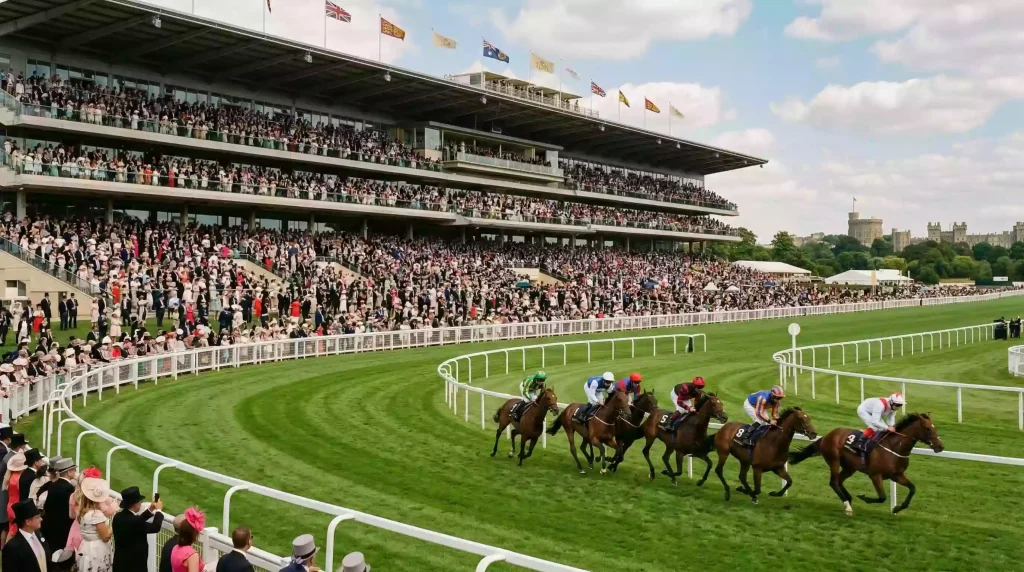
The Festivals That Shape the British Racing Year
British horse racing runs nearly every day of the year. On any given afternoon, there are meetings at racecourses from the Scottish Borders to the Devon coast, offering anything from a six-runner novice hurdle to a twenty-runner handicap sprint. Most of these fixtures pass without much attention from anyone outside the sport. The festivals are different.
A handful of meetings each year command national attention, attract capacity crowds, generate headlines, and produce results that define entire racing seasons. These are the events that casual observers know by name even if they cannot tell you what a handicap is, and they are the events that the sport’s most dedicated followers plan their entire year around.
The numbers reflect the pull. In 2025, total attendance at British racecourses reached 5,031,640 — the first time the five-million mark had been crossed since before the pandemic, representing a 4.8 per cent increase on 2024. A significant proportion of those people were drawn by the major festivals: Cheltenham, Aintree, Royal Ascot, Epsom, Goodwood, York, and a handful of others that define what UK horse racing events look like at their best.
What follows is a guide to the festivals that matter most — when they happen, what makes them distinct, and why they occupy the positions they do in the British sporting calendar.
Major UK Horse Racing Events — More on this topic at horse race winner.
Cheltenham Festival: The Championship of Jump Racing
The Cheltenham Festival in March is the centrepiece of the National Hunt season. Four days, twenty-eight races, and a level of intensity that has no equivalent elsewhere in the sport. It is, without exaggeration, the Olympics of jump racing — except that it happens every year and the emotional stakes might be higher.
The meeting is held at Cheltenham Racecourse in Gloucestershire, set in an amphitheatre-like bowl at the foot of Cleeve Hill. The natural landscape creates an atmosphere that purpose-built stadiums cannot replicate. The crowd — which peaked at 71,500 on Gold Cup Friday in 2024 — generates a sound that rolls down from the stands and across the course. In a year when total British racecourse attendance was 4,799,730, the Festival accounted for a substantial share of those numbers. Newcomers who have only watched racing on television are routinely startled by the sheer volume.
The racing programme is built around championship events. The Champion Hurdle (Tuesday) identifies the best two-mile hurdler. The Queen Mother Champion Chase (Wednesday) does the same for the two-mile chasers. The Stayers’ Hurdle (Thursday) tests three-mile hurdling excellence. And the Cheltenham Gold Cup (Friday) is the sport’s blue-riband event — three miles and two furlongs over twenty-two fences, identifying the best staying steeplechaser in training.
Between these Grade 1 centrepieces sit some of the most competitive handicaps in the calendar — the Coral Cup, the County Hurdle, the Grand Annual — where fields of twenty or more runners produce frantic finishes and frequently reward longshots. These races are a form analyst’s nightmare and a punter’s paradise: big fields, competitive marks, and results that can hinge on a moment of luck at the final obstacle.
The Festival draws runners from Ireland in significant numbers, and the Anglo-Irish rivalry that plays out across the four days is a defining feature of the meeting. In recent years, Irish-trained horses have dominated, winning the majority of races across the programme — a trend that has sharpened the competitive dynamic and raised questions about the relative strength of the two horse populations. For form analysis, the Irish involvement means that Cheltenham is one of the few meetings where you cannot rely solely on British form. Runners arrive from stables whose recent runs may have been at Leopardstown, Punchestown, or Fairyhouse — courses with different characteristics and different going patterns to anything in Britain.
The Grand National: Spectacle, Risk, and Reform
The Grand National at Aintree, held in early April, is the most famous horse race in the world. It is also the most controversial, the most unpredictable, and the one event that draws millions of people to horse racing who otherwise never give the sport a second thought. An estimated 500 million viewers watch globally. Office sweepstakes are organised by people who could not name a single other race in the British calendar. It is, in the truest sense, a national event.
The race itself is extraordinary. Up to 34 runners — the maximum field, reduced from 40 in 2024 as part of welfare reforms — tackle four miles and two and a half furlongs over thirty fences, including the iconic Becher’s Brook, the Canal Turn, and The Chair. The distance alone would be a severe test of stamina. The fences, while modified significantly in recent years to reduce risk, add a dimension that no other race can match. The Grand National is not won by the best horse in the field. It is won by the horse that combines stamina, jumping accuracy, luck, and the courage to keep galloping when its legs are burning and the obstacles keep coming.
The risk element is the source of the race’s controversy and the driver of its reform. The Grand National has historically experienced a higher incidence of falls and fatalities than standard steeplechases, and this has prompted sustained welfare scrutiny from both the public and the sport’s governing body. In response, the BHA and Aintree have implemented significant changes: fence modifications to reduce the severity of falls, field-size reductions, veterinary inspections, and course alterations designed to give horses more room on the landing side of obstacles.
The broader picture shows the same commitment to safety across all of jump racing. Modelling by the Royal Veterinary College demonstrated that the introduction of padded hurdles — replacing traditional birch with foam-padded alternatives — reduces the risk of a horse falling by 11 per cent. British racing committed to replacing all conventional hurdles with padded versions by October 2026. Meanwhile, the overall fatality rate across all codes stood at 0.22 per cent in 2025 — 192 fatalities from 86,300 starts — with jump racing at 0.47 per cent and flat turf at 0.10 per cent.
Professor Kristien Verheyen of the Royal Veterinary College, whose research underpins many of these reforms, has described the collaboration with British racing: “We’re pleased to be working in collaboration with British racing to improve our understanding of the causes of negative outcomes in racehorses. This research will greatly help the industry in making scientifically backed decisions that will benefit the welfare of the sport’s equine participants, which must be the number one priority of all involved in racing.”
For anyone approaching the Grand National as a form exercise, the standard rules apply — but with caveats. The extreme distance, the unique fences, and the large field mean that horses with Aintree experience hold a significant edge. Course form at Aintree matters more here than at almost any other meeting, and the going on the day — which can vary from Good to Soft depending on the April weather — separates the genuine contenders from the hopeful tourists.
Royal Ascot: The Crown Jewel of Flat Racing
If Cheltenham is the emotional peak of jump racing, Royal Ascot is the social and competitive peak of the flat. Five days in June, thirty-five races, and a meeting that manages to be simultaneously one of the most serious sporting events in the British calendar and one of the most elaborate exercises in public dressing-up since the invention of the top hat.
The racing is exceptional. The meeting features eight Group 1 races — more than any other fixture in the British flat season — covering distances from the five-furlong King Charles III Stakes to the two-and-a-half-mile Ascot Gold Cup. The quality of the fields is consistently elite: the best horses from Britain, Ireland, France, Japan, Australia, and beyond converge for a week that determines divisional championships across every distance category.
The Gold Cup on Thursday is the meeting’s centrepiece, a race that tests extreme stamina on the flat and routinely produces compelling narratives. The Tuesday and Wednesday cards feature the Queen Anne Stakes (a mile for older horses), the Prince of Wales’s Stakes (a mile and a quarter, often attracting Derby and Classic form), and the Coventry and Queen Mary Stakes for the most promising two-year-olds. By Saturday, the handicaps take centre stage — the Wokingham, the Hunt Cup, the Buckingham Palace — drawing huge fields and providing some of the most competitive betting races of the year.
Attendance data underscores Ascot’s pulling power. In the first half of 2025, racecourse attendance rose by 5.1 per cent year on year, with much of that growth driven by the prestige fixtures. Ascot’s ability to draw both the racing purist and the once-a-year social racegoer creates an atmosphere that is unique in British sport — knowledgeable and festive in equal measure.
For form analysis, Royal Ascot presents specific challenges. The international entries mean that form from French, Irish, and sometimes global racing must be assessed alongside British form, and the translation between different racing jurisdictions is never straightforward. Two-year-old races at the meeting are among the most speculative in the calendar — several runners will be debuting or have only one prior run — and the market relies heavily on stable reputation and trial-race performance rather than established form.
The Classics and the Epsom Derby
The five Classics are the oldest and most prestigious races in flat racing, and their influence extends far beyond the racecourse. They determine which horses become stallions and broodmares worth millions, which bloodlines dominate the next generation, and which trainers and owners earn their place in the sport’s permanent record. Winning a Classic is the single most valuable achievement in British flat racing.
The season begins with the 2,000 Guineas and the 1,000 Guineas at Newmarket in late April and early May. Both are run over a mile, and both are restricted to three-year-olds. The Guineas identify the best milers of the generation — the horses that combine speed with enough stamina to sustain it over eight furlongs. Many Guineas winners go on to illustrious careers at stud; a few attempt the longer Classics to prove they have more than just pace.
The Derby at Epsom in early June is the race that captures the public imagination. A mile and a half, around a course that is one of the most demanding in the world: a steep climb from the start, a sweeping left-hand turn around Tattenham Corner, and a downhill run to the finish that requires balance, bravery, and raw ability. The Derby has been run since 1780 and remains the race every flat owner dreams of winning. The Oaks, run over the same course and distance for fillies, takes place the day before and carries comparable prestige in breeding terms.
The St Leger at Doncaster in September completes the Classic quintet. At a mile and three-quarters, it is the longest of the five and tests genuine staying ability. The Leger has lost some of its former prominence — fewer top three-year-olds now contest it, preferring to target races at shorter distances or head for international targets — but it remains a Group 1 and a historic event that rewards the patient and the stout.
For anyone mapping the major UK horse racing events, the Classics form a spine that runs from late April to mid-September. The form generated at these meetings — particularly the Guineas and the Derby — ripples through the rest of the flat season, establishing benchmarks against which every other three-year-old performance is measured.
Goodwood, York, Doncaster, and the Supporting Cast
Below the headline festivals sits a tier of meetings that, in any other sport, would be considered major events in their own right. They attract the best horses, produce championship-quality racing, and draw substantial crowds. They simply exist in the shadow of Cheltenham, the National, and Royal Ascot — which says more about the depth of the British racing calendar than about any deficiency in these events.
Glorious Goodwood
Five days at the end of July and into early August, on a hilltop course overlooking the Sussex Downs. Goodwood’s unique topography — the track is narrow, undulating, and set in a right-hand loop with a pronounced camber — produces results that can confound form analysis. The draw matters more here than at almost any other course in Britain, and the going can change dramatically during the meeting as summer rain arrives or the ground bakes. The feature races include the Nassau Stakes, the Goodwood Cup, and the Stewards’ Cup — one of the most competitive sprint handicaps of the season, often attracting fields of twenty-five or more.
York Ebor Festival
Three days in August at York, the Knavesmire. York is widely regarded as the fairest flat course in Britain — a left-hand galloping track where the best horse tends to win, with minimal draw bias over most distances. The Ebor Festival is anchored by the Juddmonte International, a mile-and-a-quarter Group 1 that regularly attracts the best middle-distance horses in Europe, and the Nunthorpe Stakes, the most important sprint of the British summer. The Ebor Handicap itself, over a mile and three-quarters, is the richest flat handicap in Europe and one of the hardest races on the calendar to solve.
Doncaster and the St Leger Festival
Doncaster hosts the St Leger in September, the final Classic of the season. The meeting also features the Park Hill Stakes and the Doncaster Cup, both stamina tests that attract high-class older horses. The town course at Doncaster is a flat, left-handed gallop that rewards honest horses with proven stamina — a straightforward track that often produces form that translates reliably to other galloping courses.
Other Notable Meetings
Newmarket’s three major meetings — the Guineas Festival, the July Festival, and the Autumn meeting — carry enormous weight in the flat calendar. Aintree’s three-day meeting in early April includes the Grand National but also features excellent jump racing over the Mildmay course. The Punchestown Festival in late April, while officially an Irish meeting, serves as the end-of-season championship for jump racing and is widely followed by British racegoers.
The breadth of the calendar is part of its appeal — and part of the industry’s economic engine. Total prize money across British racing reached £188 million in 2024, with racecourse contributions exceeding £100 million for the first time. The distribution of that prize money across the calendar year — concentrated at the major festivals but spread across thousands of lower-profile fixtures — reflects a sport that sustains itself through volume as much as prestige.
Planning Your Raceday: Tickets, Dress Codes, and Tips
Attending a major UK racing festival is a different experience to watching at home, and the practical details matter more than most first-time racegoers expect. A few things worth knowing before you book.
Tickets and Enclosures
Most racecourses divide their facilities into enclosures, each with different levels of access and different price points. The cheapest option — often called the Open Course or Silver Ring — gives you access to the racecourse grounds and a view of the action, but limited access to bars, restaurants, and paddock viewing. The main enclosure — variously called the Grandstand, Tattersalls, or Premier Enclosure — offers better facilities and closer proximity to the parade ring, where horses are walked before each race. The top tier — the Royal Enclosure at Ascot, the Club Enclosure at Cheltenham — requires either membership or invitation and comes with dress codes that are enforced with varying degrees of rigour.
For the major festivals, tickets sell out weeks or months in advance. Royal Ascot’s Royal Enclosure requires a formal application, and first-time applicants must be sponsored by someone who has attended before. Cheltenham Festival tickets go on sale in the autumn and are gone by Christmas for the Friday Gold Cup card. If a specific meeting is on your list, book early and accept that the best seats come with a price that reflects the demand.
Dress Codes
Dress codes vary by enclosure and by meeting. Royal Ascot has the strictest requirements in British racing: men in the Royal Enclosure must wear morning dress (top hat, morning coat, waistcoat); women must wear a hat or substantial fascinator, with dresses or skirts falling below the knee. Other enclosures are less formal but still expect smart attire. Cheltenham is more relaxed — tweed, wellies, and practicality are accepted, particularly given the March weather. York, Goodwood, and Epsom fall somewhere in between: smart casual at minimum, with a general expectation that you have made an effort.
The practical advice: check the specific dress code for your enclosure before you go. Getting turned away at the entrance because your outfit does not meet the requirements is an entirely avoidable disappointment.
What to Do at the Course
Arrive early. The first race is typically at 1:30pm or 2:00pm, but the course opens well before that, and the time before racing is valuable. Walk the paddock before each race — watching horses in the flesh gives you information that no form guide can provide. A horse that is sweating heavily, fidgeting, or fighting its handler may be wasting energy before the race begins. A horse that walks calmly, with a bright eye and a loose stride, is relaxed and ready.
Study the form before you arrive. Trying to read a form guide for the first time while standing in a crowded bar with a pint in one hand is not an optimal analytical environment. Do the work the night before or on the journey in. At the course, your job is to confirm or adjust your pre-race assessments based on what you see in the paddock and hear from the going updates.
Mapping Your Racing Year
The British racing calendar is dense, and the temptation for a newcomer is to try to follow everything. That is a path to exhaustion and information overload. A better approach is to identify the festivals that align with your interests and build your year around them.
If jump racing appeals, Cheltenham in March and Aintree in April are unmissable. Add the King George at Kempton on Boxing Day and the Christmas meetings for a framework that covers the season’s key moments. If the flat is your preference, the Guineas in May, Royal Ascot in June, Goodwood and York in July and August, and British Champions Day in October give you a complete arc from Classic trials to end-of-season championships.
The major UK horse racing events are not just the best days in the calendar. They are the days that generate the form, the narratives, and the data that everything else is measured against. Following them closely — whether from the stands or from a screen — is the most efficient way to understand the sport and to sharpen the judgement that every other race on the programme demands.
See also Articles.
