
How Horse Racing Odds Work in the UK: Fractional, Decimal, and SP
 Available in US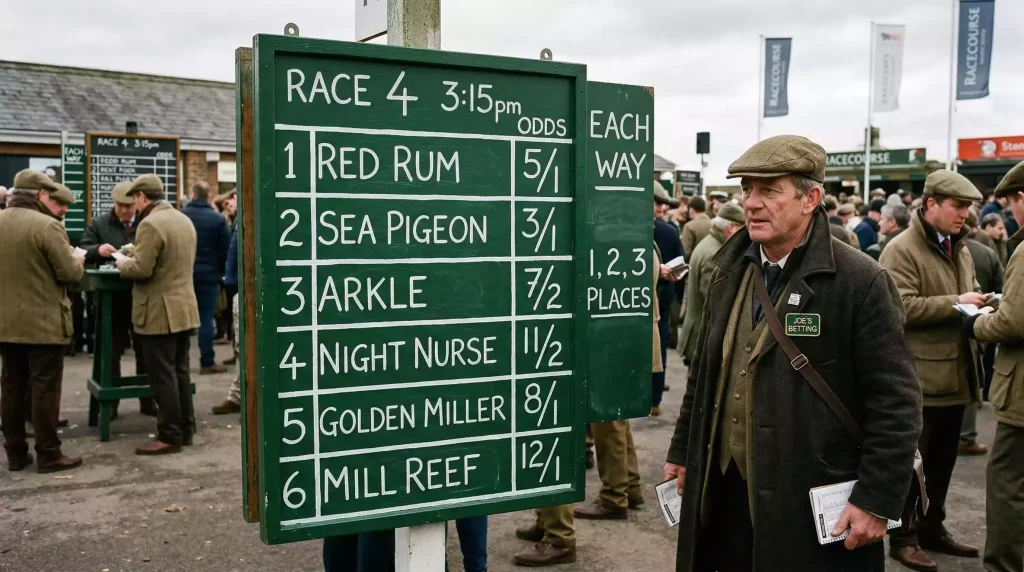
Horse racing odds in the UK are not a prediction. They are a price — the market’s collective opinion on how likely a horse is to win, expressed as a ratio of potential profit to stake. Understanding how those odds are calculated, what format they come in, and what they actually tell you about probability is not optional knowledge for anyone placing a bet. It is the baseline. Everything else — form analysis, going assessment, trainer patterns — only makes sense once you can read the language of the market.
The UK uses fractional odds as its traditional format, but decimal and implied probability conversions have become standard on betting exchanges and in data-driven analysis. Each format says the same thing in a different way. The skill is not in converting between them — any calculator can do that — but in understanding what the number represents and, more importantly, where it comes from.
How Horse Racing Odds Work in the UK — More on this topic at horse race winner.
Fractional, Decimal, and Converting Between Them
Fractional odds are the native language of British racing. A horse quoted at 5/1 (spoken as “five to one”) pays five pounds for every one pound staked, plus the return of the stake. Bet ten pounds at 5/1 and you receive sixty back: fifty in profit and ten returned. A horse at 1/2 (“one to two,” or “odds-on”) pays one pound for every two staked — shorter odds reflecting higher probability.
The logic is straightforward once you internalise it. The first number is profit, the second is stake. At 9/4, you make nine pounds profit for every four staked. At 11/8, eleven for every eight. The notation feels antiquated to anyone raised on decimal systems, and it is. Its persistence in the UK is cultural more than mathematical.
Decimal odds express the same relationship differently. A horse at 5/1 fractional is 6.00 decimal — the total return per unit staked (including the stake itself). A horse at 1/2 fractional is 1.50 decimal. The conversion formula is simple: decimal = (numerator/denominator) + 1. So 9/4 becomes (9/4) + 1 = 3.25. Decimal odds are standard on exchanges like Betfair and are increasingly used in data analysis because they are easier to multiply when calculating accumulators or cross-referencing implied probabilities.
One common source of confusion: fractional odds do not always use the same denominator. Prices like 11/10, 6/4, 100/30, and 11/8 look different from 5/1 or 3/1 because the denominator is not one. This is just convention — bookmakers price in increments that reflect their market structure, not mathematical elegance. Once you are comfortable converting to decimal, the fractional format becomes less of an obstacle. Most online sportsbooks let you toggle between the two, and doing so regularly is the fastest way to build fluency.
How Bookmakers and Exchanges Set Prices
Bookmakers do not pull odds out of thin air. The initial price for a race — the “tissue” — is compiled by odds compilers: specialists who assess each horse’s chance of winning based on form, class, going, market intelligence, and historical strike rates. The tissue represents the bookmaker’s internal estimate of probability, which is then adjusted to include the overround — the bookmaker’s margin.
In a perfectly fair market, the implied probabilities of all runners would sum to 100%. In practice, they sum to something higher — typically 110-120% for a standard UK horse race. That excess is the overround, and it is how the bookmaker guarantees a profit regardless of which horse wins. A five-runner race where each horse is priced at 4/1 (implied probability 20% each) sums to 100% — a fair book. A five-runner race priced at 3/1 each sums to 125% — a 25% overround, and much more typical.
Once the initial prices are published, the market takes over. When money comes in for a particular horse, the bookmaker shortens its odds and pushes others out. This is the betting market in its most basic form: supply and demand, expressed in probabilities. The final Starting Price (SP) is determined by an independent assessor at the course who records the odds available at the time the race starts.
Betting exchanges work differently. There is no bookmaker. Individual bettors offer prices to each other. A “backer” wants to bet on a horse winning; a “layer” is willing to take the other side. The price at which they agree is the exchange odds. Because there is no institutional overround, exchange odds tend to be slightly better than bookmaker prices — but a commission (typically 2-5%) is charged on net winnings.
Across both structures, the core finding from market analysis holds: favourites in British horse racing win approximately 30-35% of the time, while the top three in the market win 65-70% of all races combined. The market is efficient — not perfect, but efficient. Consistent long-term profit from backing favourites at SP is virtually impossible because the overround ensures the bookmaker retains an edge. The value, when it exists, lies in specific situations where the market has mispriced a runner relative to its true ability.
Starting Price vs Morning Price vs BSP
The Starting Price is the official industry price, returned on all bets placed without taking a fixed price. It is determined on-course at the moment the race begins and reflects the final state of the betting market at traditional bookmakers’ pitches. For decades, SP was the only reference point.
Morning prices change that dynamic. When bookmakers open their markets — sometimes the evening before, sometimes early on race day — they offer initial prices that can differ substantially from the eventual SP. A horse priced at 10/1 in the morning might start at 6/1 if money pours in, or drift to 14/1 if the market discovers a reason to oppose it. Bettors who take the morning price lock in that number regardless of later movement. This is why Best Odds Guaranteed (where the bookmaker pays whichever is higher, the price taken or the SP) is valued: it removes the risk of a price collapsing after you have backed a horse.
Betfair SP (BSP) is the exchange equivalent. Rather than being set by a single assessor, BSP is calculated algorithmically from all unmatched back and lay bets at the moment the race starts. BSP tends to offer marginally better value than the official SP because the exchange has no overround — only commission. The difference is not dramatic on individual races but compounds over thousands of bets, which is why professionals often use BSP as their benchmark return metric.
Which price should you target? It depends on your approach. If you bet early and are confident in your selections, locking in morning prices (with BOG protection) gives you certainty. If you prefer to wait and assess late market moves — a significant gamble or a notable drifter — taking SP or BSP keeps your options open. There is no universally “correct” answer. There is only the answer that matches your process.
Converting Odds to Implied Probability
Every set of odds can be translated into an implied probability — the chance of winning that the market is assigning to a horse. The formula is: implied probability = 1 / decimal odds. A horse at decimal 4.00 (3/1 fractional) has an implied probability of 25%. One at 2.00 (evens) is 50%. One at 1.50 (1/2) is 66.7%.
This is useful because it strips away the language of odds and forces you to think in percentages. When you believe a horse has a 30% chance of winning and the market prices it at 5.00 (implied 20%), there is a gap. That gap is where value exists — assuming your probability estimate is correct. When you believe a horse has a 15% chance and the market prices it at 3.00 (implied 33%), you are looking at an overbet favourite — a horse the market has overrated.
The discipline of converting odds to implied probability also exposes the overround clearly. Add up the implied probabilities of every horse in a race: if the total is 115%, the bookmaker is taking a 15% margin. High-overround markets are less punter-friendly. Six-runner Group 1 races tend to have lower overrounds (105-108%) than twenty-runner handicaps (118-125%). Choosing your races — not just your horses — is a legitimate part of long-term strategy.
According to analysis by Matchbook Insights, odds-on favourites in UK flat racing win roughly 55-60% of the time. Translated into implied probability at typical prices, an odds-on favourite at 1.67 (4/6) implies a 60% chance. The actual 55-60% win rate suggests the market prices these runners broadly correctly — but that the small percentage of odds-on failures (40-45% of the time) creates systematic opportunities for layers and each-way bettors on the rest of the field.
What the Numbers Do Not Tell You
Odds are the market’s best guess, shaped by form, money, and sentiment. They are not a physical property of the horse. A horse does not “become” a 3/1 shot any more than a house “becomes” worth its asking price. The number reflects an assessment — one that is often right and sometimes wrong.
Knowing how horse racing odds are calculated in the UK will not make you profitable by itself. What it will do is prevent you from being surprised by the mechanics of the market you are participating in. And in a game where most participants lose, not being surprised is a meaningful head start.
See also Each Way Betting in Horse Racing.
