
All-Weather Racing in the UK: Surfaces, Results, and How It Differs From Turf
 Available in US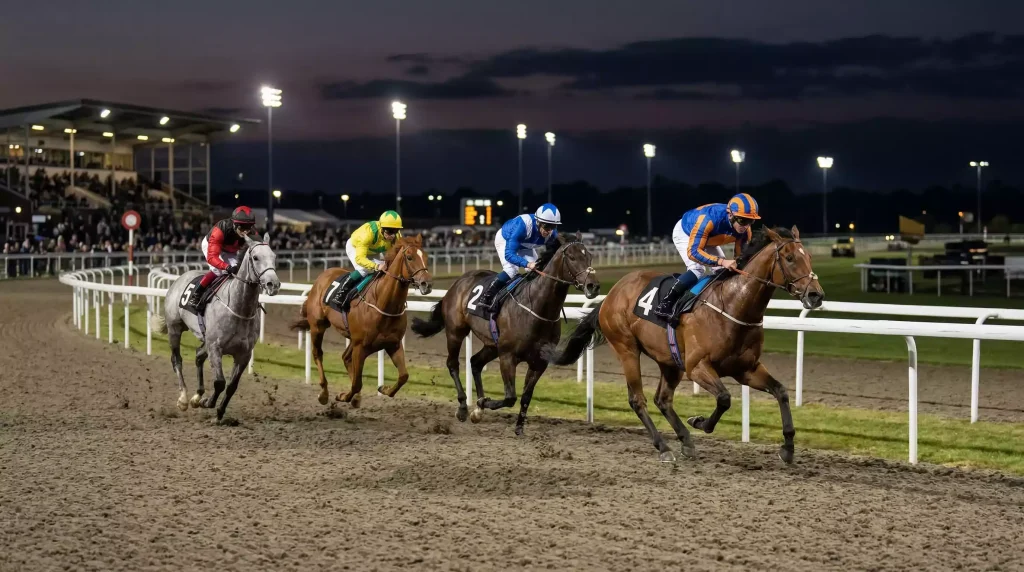
All-weather racing in the UK runs year-round, unaffected by the frost, waterlogging, and ground shifts that cause turf fixtures to be abandoned. It fills the calendar when the turf season pauses, provides a testing ground for horses between campaigns, and generates a substantial share of the sport’s betting turnover on evenings and winter afternoons when nothing else is running. Yet it occupies an odd position in the hierarchy: essential to the fixture list, undervalued in the form book, and misunderstood by bettors who treat all-weather form as interchangeable with turf.
It is not. The three artificial surfaces used at UK all-weather tracks produce measurably different race dynamics, and a horse’s record on one surface does not reliably predict its performance on another — let alone on grass. According to the BHA’s 2024 Racing Report, the number of flat runners in Britain increased by 0.5% year-on-year, and a significant share of those additional starts came on all-weather cards, where the certainty of racing — no abandonments, no going changes — makes the programme more predictable for trainers and owners alike.
All-Weather Racing in the UK — More on this topic at horse race winner.
Polytrack, Tapeta, and Fibresand: The Three Surfaces Compared
British all-weather racing uses three distinct artificial surfaces, each with its own composition, drainage characteristics, and racing profile.
Polytrack is the most widespread. Used at Lingfield, Kempton, and Chelmsford City, it consists of a blend of polypropylene fibres, recycled rubber, and silica sand bound with a wax coating. The surface is designed to provide consistent footing across a range of weather conditions, draining rapidly after rain and retaining enough moisture to avoid becoming excessively firm in dry spells. Racing on Polytrack tends to favour horses with a smooth, economical action — the surface has a slight “give” that rewards efficiency of movement rather than raw power.
Tapeta is used at Newcastle and Wolverhampton. Developed by Michael Dickinson, a former champion jump trainer turned surface engineer, Tapeta combines sand, wax, and synthetic fibres in a formulation that Dickinson has refined over decades. The surface rides slightly firmer than Polytrack and produces marginally faster times at equivalent distances. Horses that handle Tapeta well tend to be those that act on good-to-firm turf — the surface rewards speed and a forward-going running style more than Polytrack does.
Fibresand is the outlier. Used only at Southwell, it consists of sand reinforced with polypropylene fibres and no wax coating. It rides deeper and slower than either Polytrack or Tapeta, demanding more stamina and producing longer race times. Fibresand is the surface that most closely resembles heavy turf in terms of physical demand, and horses that struggle on testing ground generally struggle at Southwell too. The surface has a loyal following among a subset of trainers who target Southwell specialists — horses that love the deep ground and outrun their form on any other surface.
The practical consequence for form analysis is that all-weather form is not a single category. A horse with five wins at Lingfield (Polytrack) is a Polytrack specialist, not an “all-weather specialist.” Its form may translate to Chelmsford (also Polytrack) but tells you very little about how it will handle Tapeta at Wolverhampton or Fibresand at Southwell. Treating all three surfaces as equivalent is a common analytical error and one of the easiest to correct.
Form Crossover: AW to Turf and Back
The central question for any bettor encountering a horse with all-weather form is whether that form transfers to turf. The answer, unhelpfully, is: sometimes.
Horses that win on Polytrack or Tapeta in winter and then switch to turf in the spring are a staple of the flat season. Some improve markedly on grass — the natural surface suits them better, and their all-weather efforts were merely keeping them fit. Others regress, finding that the pace dynamics, ground variation, and larger fields of turf racing expose limitations that the controlled all-weather environment concealed.
The most reliable crossover indicator is the specific all-weather surface. Tapeta form translates to good-to-firm turf more reliably than Polytrack form, because the two surfaces share a similar speed profile. Fibresand form translates to soft or heavy turf conditions better than the other two surfaces. These are tendencies, not rules — but they are tendencies supported by years of results data.
The reverse crossover — turf form predicting all-weather performance — is equally imperfect. A horse that has won three times on good ground at Newmarket is not guaranteed to handle the kickback, the artificial surface, and the tighter turns of Wolverhampton. Horses that dislike dirt in their face (a common issue on all-weather tracks, where the surface throws up debris) may underperform regardless of ability. Blinkers and visors are more commonly applied on all-weather cards partly for this reason — they help horses that are unsettled by kickback to focus forward.
Odds-on favourites on UK flat turf win roughly 55-60% of the time. On all-weather surfaces, the rate is broadly similar for short-priced horses, but the overall market efficiency is slightly lower — partly because the form lines are less well-analysed by the public, and partly because the smaller, more regular fields produce more predictable results for those who pay attention to surface-specific data.
The All-Weather Courses
Six racecourses in Britain host all-weather flat racing. Each has its own character.
Lingfield in Surrey is the flagship all-weather venue, hosting the All-Weather Championships Finals Day in spring — the most valuable day of all-weather racing on the calendar. Its Polytrack circuit is left-handed, roughly ten furlongs round, with a short straight that favours prominent racers.
Kempton Park, also on Polytrack, is a right-handed triangular track with a longer straight and a fairer configuration. It races on the all-weather during the flat season’s quieter months and shares its venue with the jump course that hosts the King George on Boxing Day.
Chelmsford City, the newest all-weather venue, opened in 2015 on a Polytrack surface. The track is left-handed and broadly fair, with evening meetings drawing strong fields and competitive prize money.
Newcastle runs on Tapeta and hosts all-weather racing through the winter, complementing its turf programme in summer. The wide, left-handed track suits galloping types and produces form that cross-references reasonably well with York and Doncaster on turf. Wolverhampton is also Tapeta, right-handed, and tight — a sharp track that favours speed and front-runners.
Southwell stands alone on Fibresand. Its left-handed, oval track produces racing unlike anywhere else in Britain. Specialist form is paramount here: a horse’s previous Southwell record is the single most predictive variable in assessing its chances.
All-Weather as an Analytical Opportunity
All-weather racing is the part of the fixture list that receives the least analytical attention from the public and, consequently, offers some of the most accessible value for those willing to do the work. Surface-specific form, stable patterns (certain trainers target all-weather cards with particular types of horse), and the controlled conditions (no going changes, consistent ground, no weather-related scratchings) make it a more predictable environment than turf — once you accept that the data must be read on its own terms, not as a footnote to the grass season.
See also Handicap Races Explained.
