
What Does Going Mean in Horse Racing? Ground Conditions Explained
Best Horse Racing Betting Sites – Bet on Horse Racing in 2026
Loading...
Why Ground Beneath the Hooves Decides More Races Than Form
Every horse has a form profile, a rating, a trainer with a plan, and a jockey with a strategy. And yet none of those things matter as much as what is happening underfoot. The going — the condition of the ground at a racecourse — shapes the outcome of more races in British racing than any single variable, and it does so in ways that are measurable, predictable, and consistently underestimated.
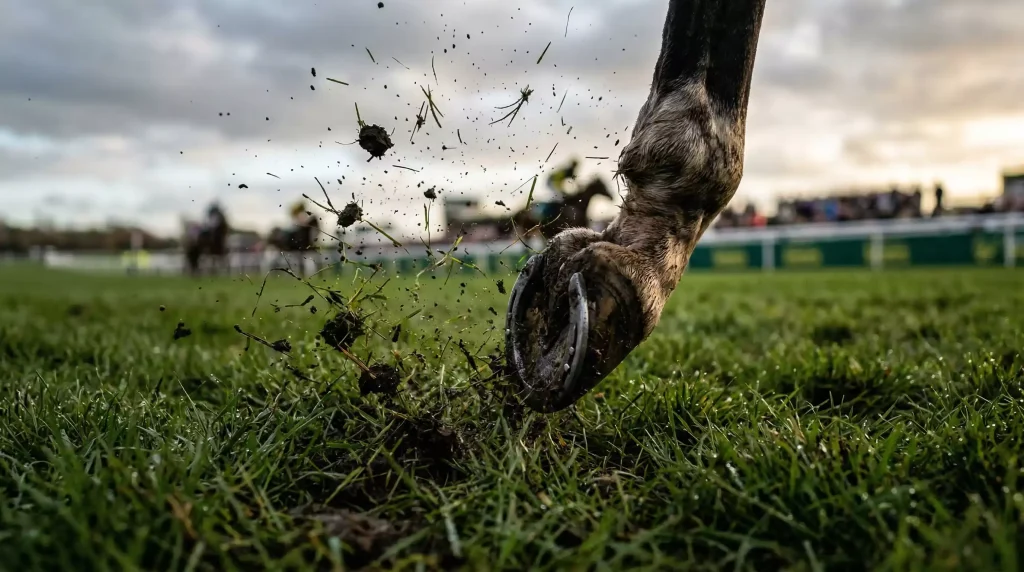
The logic is straightforward. A horse that moves best on fast, firm ground is a different animal on rain-soaked turf. The mechanics of stride, the energy cost of each footfall, the risk of slipping — all of these change with the ground. A heavy horse with a powerful, flat action might thrive when the surface is quick. A lighter horse with a high, rounded action might float over ground that has others labouring. What going means in horse racing is, fundamentally, the physical environment in which the competition takes place — and it is not the same from one day to the next.
Here is the scale of the issue. Analysis of over 6,000 UK races between 2016 and 2024 found that between 71 and 85 per cent were run on some variant of Good ground: Good to Firm, Good, or Good to Soft. That sounds reassuring — most races are run on decent ground, so perhaps going does not matter that much. But it means the remaining 15 to 29 per cent of races happen on ground that is either significantly faster or significantly softer than the norm. And in those races, the horses that handle the conditions separate themselves from those that do not — often by wide margins.
This article explains the going scale used in British racing, how ground conditions are measured and reported, and why the data should influence your race-by-race assessments more than almost any other factor on the card.
The Official Going Scale: Firm Through Heavy
British racing uses a verbal scale to describe turf conditions, ranging from Hard at the fastest extreme to Heavy at the slowest. The scale, as applied by clerks of the course and reported in race cards, runs in the following order from quickest to most testing:
Hard. Bone-dry ground with virtually no give. Rare in Britain — you are more likely to encounter it during an unusually prolonged dry spell in midsummer. Many trainers will withdraw their horses rather than risk injury on ground this firm. It punishes joints and tendons, and the jarring action it produces is uncomfortable for most horses. Racing on Hard ground is uncommon enough that some horses go entire careers without experiencing it.
Firm. Dry ground with minimal moisture. Fast, but less extreme than Hard. Horses with a low, economical action tend to excel on Firm ground because they waste less energy on each stride. Stamina is less of a factor because the surface does not drain energy the way soft ground does. Flat racing in midsummer — particularly on well-drained chalk downland tracks like Salisbury or Goodwood — often produces Firm conditions.
Good to Firm. Arguably the ideal surface for flat racing. The ground is dry with enough moisture to provide a slight cushion, minimising jar while still offering a fast surface. The majority of fast flat times and peak performances occur on Good to Firm going. It is the ground on which the broadest range of horses perform close to their best, which is why it dominates the summer months.
Good. The default condition and the most common going description in British racing. Good ground has adequate moisture to produce safe footing without being soft enough to slow horses down significantly. It accommodates most running styles, which is why trainers and jockeys are generally happy to run on it regardless of their horses’ preferences. When you hear a trainer say a horse “acts on any ground,” they usually mean it acts on Good ground in all its minor variations.
Good to Soft. The ground is starting to take water. Footprints leave a visible impression, and the surface has a slight give that demands more effort per stride. Horses that were borderline on Good ground — adequate but not excelling — will often see their performance dip on Good to Soft. Conversely, horses with a rounded action and a high knee lift often come into their own. This is the going description that most frequently separates the genuine soft-ground performers from the rest.
Soft. The ground is wet and holding. Horses sink noticeably with each stride, and the energy cost of covering a mile on Soft ground is substantially higher than on Good. Stamina becomes a dominant factor. Speed horses — those who rely on a quick turn of foot to accelerate in the final furlong — often find that their finishing kick is blunted because the ground takes too much out of them earlier in the race. National Hunt racing in winter produces Soft ground as standard on many courses, and some jumps trainers build their entire season around it.
Heavy. Saturated ground. Water pools in the lower areas of the track, and horses can visibly labour through it. Heavy ground transforms a race into a test of endurance and determination rather than speed. Fields are often depleted because trainers withdraw horses unsuited to the conditions. The horses that win on Heavy ground are a specific type: powerful, low to the ground, relentless. They do not always look like athletes, but they do the one thing that matters — they keep going when everything else stops.
The In-Between Descriptions
In practice, going is often described in compound terms: Good to Firm in places, Soft to Heavy, Good (Good to Soft in places). These reflect the reality that a racecourse is not a uniform surface. The ground near the inside rail, where most horses run, is often more worn than the ground further out. Low-lying sections of a track hold water longer than elevated stretches. A clerk of the course walking the track at 8am might find the going to be Good on the home straight and Good to Soft on the far side. The official going report is a summary — and, like all summaries, it loses some nuance. Experienced racegoers listen to reports from the course, check the morning inspection updates, and adjust accordingly.
How Going Is Measured: GoingStick, Clerk of the Course, and Science
For decades, going was assessed by one method: a clerk of the course walked the track, pushed a walking stick into the turf, and gave their opinion. The system worked after a fashion, but it was subjective. Two clerks could walk the same patch of ground and arrive at different descriptions. The introduction of the GoingStick in 2007 brought a degree of objectivity to the process — and recent academic research has pushed the science considerably further.
The GoingStick
The GoingStick is a handheld device that measures two properties of the turf: penetration (how deep it sinks into the ground) and shear (the resistance the ground offers when the stick is rotated). These two readings are combined into a single numerical score that maps onto the verbal going scale. A score above 10 typically indicates Good to Firm or firmer. Below 6 is Soft to Heavy territory. Clerks of the course take multiple readings across different sections of the track, and the average is reported alongside the verbal description.
The GoingStick is an improvement on pure guesswork, but it has limitations. It measures a single point at a single moment. The ground changes throughout a raceday — rain during racing, the pounding of hooves on the inside rail, watering by groundstaff between meetings — and the GoingStick reading from 8am may not accurately reflect conditions by the 4:30 race. Most courses update the going report at intervals during the day, but gaps remain.
The Science: Cushioning and Performance
In 2024, a research team led by Professor Sarah Jane Hobbs at the University of Central Lancashire, working with colleagues at Nottingham Trent University, published findings that moved the understanding of going from description to measurement. Their study examined the relationship between a physical property of the turf called cushioning — essentially the force the ground exerts back on a horse’s hoof — and actual race times. The results were striking. Cushioning values explained 81.9 per cent of the variation in what the researchers termed “performance going,” with an adjusted r-squared of 0.819. In plain language, a single physical measurement of the ground predicted how fast horses would run on it better than any combination of verbal descriptions or subjective assessments.
The study also identified a threshold. Horse speeds reached a plateau when cushioning measured around 10 kilonewtons — roughly twice the weight of a horse. Below that level (softer ground), horses slowed in a predictable, linear fashion. Above it (firmer ground), making the surface even harder did not produce any additional speed. This finding has practical implications for anyone trying to understand what going means in horse racing: there is a measurable point at which firm becomes firm enough, and beyond it, the advantage disappears.
Professor Hobbs described the broader significance of the work: “We have been working alongside an international team of researchers since London 2012 with the goal of advancing our capability to measure and improve equine surfaces.” The research, highlighted by Nottingham Trent University as part of an ongoing effort to improve racecourse surfaces, benefits not just the horses but anyone attempting to use going data to assess race outcomes.
Seasonal Patterns: When UK Ground Shifts
Britain’s weather does not follow a script, but it does follow broad patterns — and so does the going. Understanding when ground conditions tend to change across the racing year is essential for anyone making assessments based on form run on particular surfaces.
The flat season begins in earnest in April and runs through October, with the turf season peaking in the summer months. In early spring, residual moisture from winter means the ground is often Good to Soft or Soft, particularly at courses in the north and west of England, Wales, and Scotland. By late May, drier weather typically brings conditions to Good, and by midsummer — July and August — Good to Firm is common, with Firm conditions appearing during prolonged dry spells. The autumn brings a gradual return to softer ground as the days shorten and rainfall increases, with October often producing Good to Soft or Soft conditions.
National Hunt racing runs year-round, but its core season stretches from October through to April. The going follows the season: autumnal meetings start on Good or Good to Soft, the winter months deliver Soft and Heavy as standard, and the spring sees conditions begin to dry out for the showcase festivals. Cheltenham in March can be anything from Good to Heavy depending on the year, and the difference in going between one year’s Festival and the next can reshape the results entirely. A horse that won the Champion Hurdle on Good ground may not reproduce that form on Heavy — and vice versa.
The data supports the pattern. Analysis of UK race conditions between 2016 and 2024 shows that in the first quarter of the year, approximately 58 per cent of races took place on Soft or Heavy ground. By the third quarter — July through September — that figure fell to around 13 per cent. The shift is dramatic, and it means that horses trained for the spring jumps season face fundamentally different conditions to those competing in the summer flat campaign. The seasonal going pattern is, in effect, a filter that determines which horses are suited to which part of the calendar.
Trainers who operate across both codes — and some do — plan their campaigns around these shifts. A dual-purpose horse might run on the flat in summer on Good to Firm ground, then switch to hurdles in the autumn as conditions soften. The form guide records these transitions, but interpreting them requires an awareness that a horse’s run on Soft ground in November is not a fair comparison to its run on Good to Firm in July. They are, to a meaningful extent, different horses on different days.
All-Weather Surfaces: Standard, Slow, and Predictable
Not all racing in Britain takes place on turf. Six courses — Chelmsford City, Kempton Park, Lingfield Park, Newcastle, Southwell, and Wolverhampton — race on artificial surfaces, collectively known as all-weather (AW). These tracks provide year-round racing regardless of the weather, which is their primary purpose: when frost or waterlogging cancels turf meetings, the all-weather programme keeps the fixture list intact.
All-weather surfaces use a different going scale. Instead of Firm through Heavy, AW going is described as Fast, Standard to Fast, Standard, Standard to Slow, or Slow. The range is narrower and the variation is smaller. A heavy downpour might shift a turf course from Good to Soft within a couple of hours. The same rain on a Polytrack or Tapeta surface might nudge the going from Standard to Standard to Slow, but the change in performance is comparatively modest.
Surface Types
Three surface types are in use across the six AW courses. Polytrack, a blend of polypropylene fibres, rubber, and silica sand coated in wax, is used at Chelmsford, Kempton, and Lingfield. Tapeta, a mix of sand, fibres, and rubber granules, is used at Newcastle and Wolverhampton. Southwell uses Fibresand, which is closer in characteristics to soft turf than the other two surfaces.
Each surface rides differently. Polytrack and Tapeta produce a consistent, moderately fast surface that tends to favour horses with a level, fluent action. Fibresand is more demanding — horses that handle cut in the ground on turf often adapt to Southwell more easily than those who prefer fast ground. The distinction matters because a horse’s AW form at Wolverhampton (Tapeta) may not transfer to Southwell (Fibresand), even though both are nominally all-weather tracks.
AW Form as a Going Indicator
All-weather form has a peculiar relationship with turf form. Some horses perform well on both surfaces and their form transfers reliably. Others are AW specialists — they thrive on the consistent, level surface and struggle when faced with the unpredictability of turf. And a third group does the opposite: they are natural turf horses who never quite adapt to the artificial kickback and the different feel underfoot.
For the purposes of understanding going, the key point about all-weather racing is that it removes the ground variable almost entirely. When a horse runs on Standard ground at Kempton, you know the surface is consistent. That makes AW form a useful benchmark for isolating other factors — speed, stamina, class — without the interference of changing going conditions. It does not make AW form better or worse than turf form. It makes it different, and the distinction is worth bearing in mind when cross-referencing form across surfaces.
Using Going Data to Refine Your Selections
Knowing what going means in horse racing is the foundation. Using it to make better assessments is the application. The gap between the two is where most people lose value — they check the going, nod, and then ignore it when something else catches their eye. That is a mistake.
The first step is simple: before looking at anything else on a race card, check the going. Not just the headline description, but the updates. Has it been raining? Has the going changed since declaration time? A horse that was declared on Good to Firm might find itself running on Good to Soft if the forecast was wrong. If that horse’s record on softer ground is poor, the entire picture changes — regardless of how impressive the rest of the form looked.
Going and Favourite Reliability
The going also affects the reliability of market signals. Favourites win around 30 to 35 per cent of UK races across all conditions, but that average masks significant variation by going. On Good to Firm ground, where the surface is predictable and the best horses tend to perform to their ratings, favourite win rates trend toward the higher end of the range. On Heavy ground, where stamina and ground preference become dominant, favourites are less reliable because the conditions introduce variables that the market cannot always price correctly.
This does not mean you should automatically oppose favourites on soft ground. It means the going is another lens through which to evaluate whether the market has the right horse at the top. A favourite with a proven record on Soft ground is a stronger proposition on that surface than a favourite whose going record is untested or unfavourable. The form guide provides the data. The going provides the context.
Building a Going Filter Into Your Process
A practical approach is to treat going as a pass-fail filter before engaging with any deeper analysis. Take the declared going and check each runner’s record on that ground — or, more precisely, on ground in the same broad category. If a horse has never run on Soft ground and today’s going is Soft, you do not know how it will handle the conditions. That is not a reason to eliminate it entirely, but it is a reason to rank it below horses with a proven record on the surface.
For horses with extensive going records, the numbers are often conclusive. A horse showing 5 wins from 9 runs on Good to Soft and 0 wins from 7 runs on Good to Firm is telling you something specific: it is a soft-ground horse, and backing it on fast ground is ignoring the strongest evidence available. The temptation, especially when such a horse has strong recent form on different ground, is to assume it will adapt. Sometimes it does. More often, it does not.
Going data is also useful for spotting value in horses coming off a poor run. A horse that finished last on Heavy ground but has a solid record on Good is not a spent force — it ran on the wrong surface. If today’s going is Good, that poor run should be discounted rather than treated as evidence of decline. The form guide tells you the finishing position. The going record tells you whether the finishing position was representative.
Ground Truth: Checking Going Before Every Race
The going is the single most accessible, most measurable, and most consistently informative variable in British horse racing. It is publicly reported, frequently updated, and directly relevant to every runner in every race. And yet it remains the factor that the largest number of people treat as secondary — something to glance at rather than analyse.
The science is moving in the right direction. The work by researchers at UCLan and Nottingham Trent University has shown that ground conditions can be quantified with a precision that the verbal going scale was never designed to capture. The 10 kilonewton cushioning threshold — the point at which firmer ground stops producing faster horses — is the kind of finding that changes how the relationship between surface and performance should be understood. It is no longer a matter of opinion. It is physics.
For anyone serious about assessing race outcomes, the routine is straightforward. Check the going first. Check it again closer to race time. Cross-reference each runner’s going record against the reported conditions. Discount runs made on unsuitable ground. Upgrade runs made on today’s surface. Do this before looking at the ratings, the jockey bookings, or the market price. The ground beneath the hooves is where the race begins — and more often than most people realise, it is where the race is decided.