
Royal Ascot Guide: Races, Dress Code, and Betting Insights
Best Horse Racing Betting Sites – Bet on Horse Racing in 2026
Loading...
Royal Ascot is British flat racing at its most theatrical. Five days in June, thirty races, and a level of pomp that no other sporting event in the country attempts. But behind the top hats and the Royal Procession is a meeting that produces some of the most competitive, internationally significant flat racing of the year. A Royal Ascot guide needs to cover both dimensions: what to wear and where to stand, certainly — but also which races matter, how the form lines develop, and where the betting value tends to sit across a week that draws runners from half a dozen countries.
The meeting’s pulling power is not slowing down. In the first half of 2025, Royal Ascot’s attendance rose 4.8% year-on-year, part of a broader 5.1% increase in racecourse attendance nationally. The five days attract a cumulative crowd that comfortably exceeds 300,000, making it the best-attended flat racing meeting in Europe.
The Race Programme
Royal Ascot runs from Tuesday to Saturday, with six races each day. The programme covers every division of flat racing, from two-year-old sprints to the Gold Cup’s two-and-a-half-mile stamina test.
Tuesday opens with the Queen Anne Stakes, a Group 1 over a straight mile that typically attracts the best milers in training from Britain, Ireland, France, and sometimes Japan or Australia. The King’s Stand Stakes (Group 1, five furlongs) is the premier sprint of the meeting, run on the same afternoon. The Coventry Stakes — a six-furlong Group 2 for two-year-olds — provides the first glimpse of the next generation and is historically a strong pointer towards the following year’s Classics.
Wednesday features the Prince of Wales’s Stakes, a Group 1 over a mile and two furlongs that regularly produces clashes between Derby winners and seasoned older horses. The Royal Hunt Cup, a one-mile handicap with a field limit of thirty, is the meeting’s biggest betting race — a punter’s puzzle where draw, pace, and class collide in a field so large that the market cannot efficiently price every runner.
Thursday — Gold Cup Day — is the centrepiece. The Gold Cup itself is run over two miles and four furlongs, a distance that exists almost nowhere else on the British calendar. It rewards extreme stamina, and its roll of honour includes Stradivarius (four wins, 2018-2021), Yeats (four wins, 2006-2009), and Sagaro (three wins, 1975-1977). For many racegoers, Thursday is the social highlight of the week as well as the sporting one.
Friday brings the Commonwealth Cup (Group 1, six furlongs, three-year-olds), the Coronation Stakes (Group 1, one mile, three-year-old fillies), and the Duke of Edinburgh Stakes — another fiercely competitive handicap. Saturday closes the meeting with the Diamond Jubilee Stakes (Group 1, six furlongs), the Hardwicke Stakes (Group 2, mile and a half), and the Wokingham Stakes, a six-furlong cavalry charge that is arguably the most difficult race at the entire meeting to analyse.
The programme is designed so that each day has at least one Group 1 and at least one major handicap. This structure creates a dual appeal: the purist can follow the championship races, while the handicap bettor can find large-field puzzles every afternoon.
Enclosures and Dress Code
Royal Ascot operates three main enclosures, each with its own dress code and atmosphere.
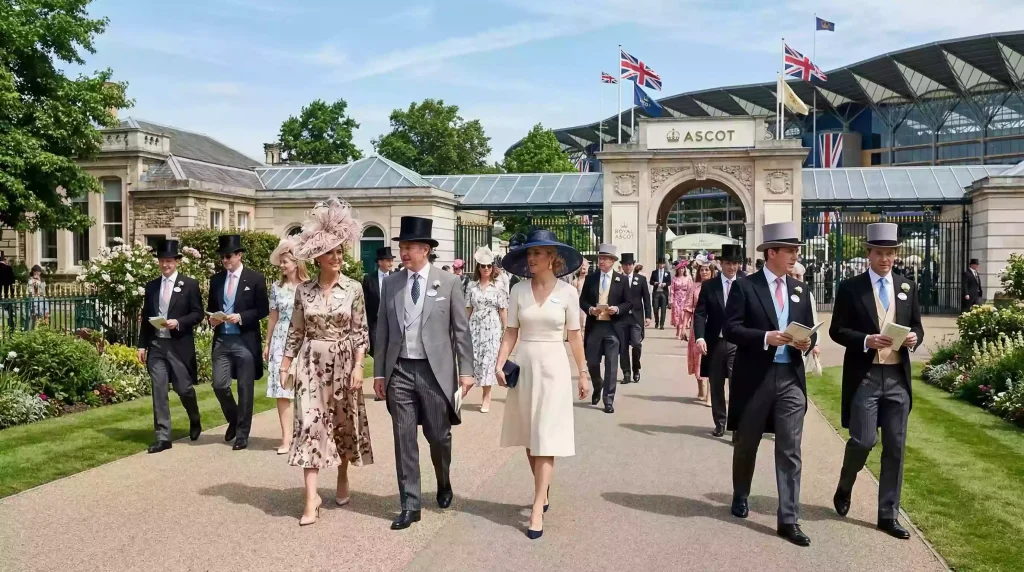
The Royal Enclosure is the most exclusive. Access requires membership (applied for well in advance) or a voucher from an existing member. The dress code is strict: morning suit with a top hat for men, formal daywear with a hat or substantial fascinator for women. Hemlines must fall below the knee. Trouser suits are permitted. This is not the place for casual experimentation — the dress code is enforced at the gate, and non-compliant visitors are turned away regardless of their ticket.
The Queen Anne Enclosure (formerly the Grandstand) is the next tier. The dress code is slightly relaxed but still formal: a suit and tie for men, a hat or fascinator for women, smart attire throughout. It offers excellent views of the racecourse and access to a wide range of bars and restaurants.
The Windsor Enclosure offers the most accessible entry point. Smart casual dress is the minimum — no trainers, no fancy dress, no sportswear. It is the most affordable option and the most popular with first-time visitors. The racing experience is the same — same races, same results, same bookmakers — but the atmosphere is noticeably more relaxed.
All three enclosures sell out well in advance. Hospitality packages, which combine private dining with course access, add a further layer but at prices that place them firmly in the corporate entertainment bracket.
Attendance and the Economics of the Meeting
Royal Ascot’s financial significance extends beyond ticket sales. The meeting is a major driver of prize money — the total prize fund across five days exceeds eight figures, funded through a combination of racecourse revenue, sponsorship, and Levy Board contributions. The total prize money across British racing in 2024 reached £188 million, with racecourse executive contributions exceeding £100 million for the first time. Royal Ascot represents a disproportionate share of that spend, both because of its status and because its commercial revenues (hospitality, media rights, sponsorship) are among the highest of any meeting in the world.
The attendance growth matters for the sport beyond the balance sheet. Royal Ascot’s ability to attract new racegoers — drawn by the social occasion rather than the form book — creates a pipeline of potential future racing fans. Whether those visitors return for a midweek meeting at Windsor or Kempton is the industry’s ongoing challenge, but Ascot in June is where many people encounter live racing for the first time.
Betting Angles
Royal Ascot is a meeting where international form intersects with domestic form in ways that are difficult to assess. French, Irish, American, and occasionally Australian and Japanese runners enter many of the Group races, bringing form lines that British bookmakers are less equipped to evaluate accurately. This creates pricing inefficiencies — not enormous ones, but enough to matter over the course of five days.
The big handicaps — the Royal Hunt Cup, Wokingham, and Buckingham Palace Stakes — are where the most value tends to concentrate for UK-focused bettors. These races have large fields, generous each-way terms, and enough variables that the market cannot price every runner precisely. A systematic approach — filtering by draw (the straight course at Ascot can show draw bias depending on the ground), recent form, trainer intent, and jockey booking — tends to narrow the field to a manageable shortlist.
For the Group races, the market is sharper. Favourites at Royal Ascot’s Group 1 events tend to be well-found — they are short for a reason, and the international nature of the competition means that the best horse usually wins. Opposing a Group 1 favourite at Ascot is not contrarian thinking. It is usually just wrong.
Five Days That Set the Flat Season’s Agenda
Royal Ascot does not just reflect the state of flat racing — it redirects it. Reputations are made and destroyed in five afternoons. Horses emerge as Arc contenders, Champions Day targets, and stallion prospects. The form produced here ripples through the calendar for months. Approaching it without preparation — without knowing the programme, the track, the draw, and the dress code — is the fastest way to waste one of the best weeks in British sport.