
Best UK Racecourses for Flat Racing: Track Profiles and Guide
Best Horse Racing Betting Sites – Bet on Horse Racing in 2026
Loading...
Britain has 59 racecourses, and anyone who tells you they all ride the same is either lying or has never watched a race. The best UK racecourses for flat racing are not simply the ones that host the richest events — they are the tracks whose layouts, surfaces, and quirks have shaped the sport’s form book for generations. A horse that handles Epsom’s camber may loathe Newmarket’s long straight. A sprinter that thrives on Chester’s tight bends might be lost on Ascot’s sweeping turns. Knowing the track is not supplementary analysis. It is primary.
In the first half of 2025, racecourse attendance across Britain rose 5.1% year-on-year, with major flat festivals driving the growth. Royal Ascot alone saw a 4.8% increase. These numbers reflect what punters and racegoers already know instinctively: the top flat courses offer something more than just a race — they offer a stage where the best horses are genuinely tested.
Ascot
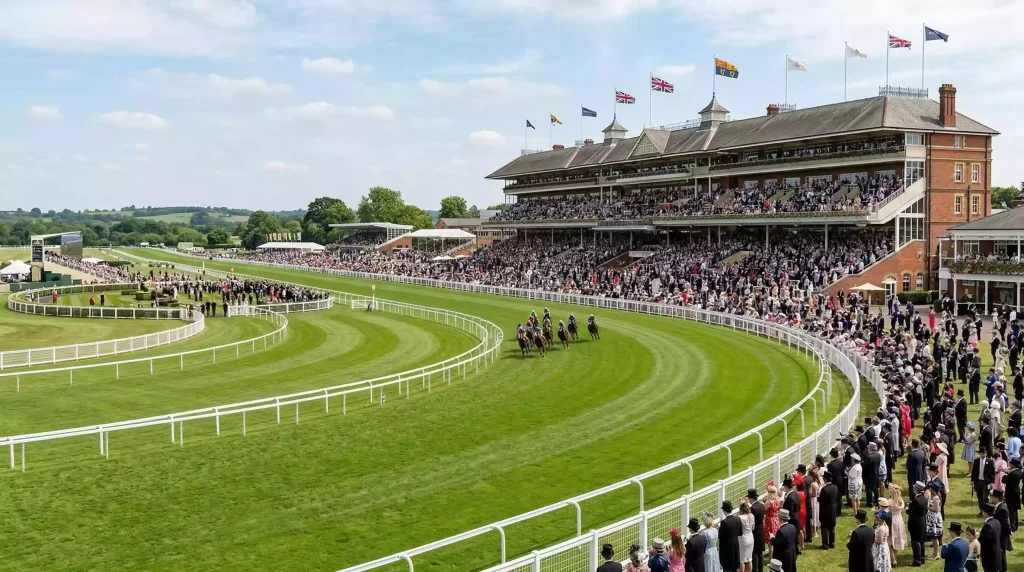
Ascot is British flat racing’s flagship venue. The right-handed, triangular course is roughly a mile and six furlongs round, with a stiff uphill finish that separates the genuine stayers from the flatterers. The straight course — used for races of a mile or less — runs uphill for the final two furlongs, a feature that catches out front-runners who have used up their reserves too early.
Royal Ascot in June is the centrepiece of the flat calendar. Five days, thirty races, Group 1 action every afternoon. The ground is typically good to firm, watered to maintain safe going, and the fields are among the deepest in European racing. The King George VI and Queen Elizabeth Stakes in late July provides a midsummer clash between the Classic generation and older horses over a mile and a half. For form analysts, Ascot form is premium currency — the depth of competition means a good run here translates reliably to other top tracks.
Draw bias at Ascot varies by distance. On the straight course, a high draw (far side from the stands) has historically shown a slight advantage when the ground is soft, because the rail on that side tends to offer firmer footing. On the round course, the draw matters less because the field covers enough distance for position to settle naturally.
Newmarket
Newmarket is the headquarters of British racing and home to two distinct courses: the Rowley Mile (used in spring and autumn) and the July Course (used in summer). Both are right-handed, wide, and galloping — the kind of track where a horse with genuine speed and stamina can operate without being compromised by tight turns or undulations.
The Rowley Mile is where the Classics begin. The 2000 Guineas and 1000 Guineas are run here in early May, over a straight mile that finishes on a slight rise known as “the Dip” — a depression about a furlong from the post that can momentarily flatten a horse’s stride before the ground rises again to the line. Horses that idle in front or lose momentum at the wrong moment often get caught in the Dip. It is a subtle feature with outsized consequences.
The July Course hosts the July Festival and the prestigious July Cup, one of Europe’s top sprints. The track is slightly different in character — still wide and galloping, but with less of the Dip effect. Summer ground is typically fast, which suits speed horses over front-runners who want to dictate. Newmarket form is highly respected because the track’s fairness and consistent surface make it a reliable measure of ability.
Epsom
Epsom is unlike anything else in British racing. The left-handed course climbs steeply for the first half-mile, bends left around Tattenham Corner on a pronounced camber, then drops sharply downhill into a final three furlongs that sweep left again to the finish. It is a mile-and-a-half test that demands balance, agility, and a particular temperament. Horses that cannot handle the camber drift wide at Tattenham Corner and lose ground they can never recover.
The Derby is run here on the first Saturday of June, and it remains the race that every flat trainer in Britain and Ireland wants to win. Derby form is considered the gold standard for assessing three-year-olds, but with a caveat: Epsom specialists — horses that handle the track’s idiosyncrasies — sometimes outperform rivals who are objectively better on more conventional courses. Watching how a horse handles the camber and the downhill run is critical; race replays from Epsom reveal more about a horse’s racing style than those from almost any other venue.
York, Goodwood, and Doncaster
York is often described as the fairest flat track in Britain. Left-handed, wide, and essentially flat with a long straight, it allows horses to race on their merits without being disadvantaged by the draw, tight bends, or unusual gradients. The Ebor Festival in August is the track’s showpiece — four days of top-class racing headlined by the Juddmonte International, a Group 1 over ten and a half furlongs that regularly attracts the best middle-distance horses in training. York form is clean: if a horse runs well here, it is genuinely good.
Goodwood could not be more different. Set on the Sussex Downs, the right-handed track is undulating, with a pronounced downhill section in the back straight and a sharp right-hand bend into the home straight. The Glorious Goodwood meeting in late July is five days of high-summer racing, famous for the Sussex Stakes (Group 1, one mile) and the Goodwood Cup (Group 1, two miles). The track’s idiosyncrasies mean that horses need to handle undulations and an uneven pace — raw speed is less important here than adaptability.
Doncaster is a left-handed, flat, galloping track — similar in character to York but with a longer straight and slightly less depth of racing outside its flagship meetings. The St Leger, run in September, is the final Classic of the season: a mile and six furlongs that tests stamina more than any other Classic race. Doncaster also hosts the Lincoln Handicap — traditionally the first big flat handicap of the year — and the Doncaster November Handicap at season’s end, making it a bookend venue for the flat calendar.
Draw Bias: The Hidden Variable
Draw bias is the statistical tendency for certain stall positions to produce more winners than others at a given course and distance. It is not universal — some tracks show minimal draw bias, while others have strong, persistent patterns.
Chester is the most extreme example. The tight left-handed circuit, barely a mile round, gives a pronounced advantage to low draws (near the inner rail) in sprint races. A horse drawn in stall one at Chester over five furlongs has a structural advantage that no amount of ability from a wide draw can easily overcome. At Beverley, high draws over sprint distances hold an edge because the track’s configuration favours the far side. At Ascot on the straight course, it depends on the going and the prevailing conditions on race day.
For any serious form student, checking the draw statistics at the relevant course and distance is a non-negotiable step. Several free databases publish historical draw data broken down by track, distance, and going. A horse with good form, a suitable course profile, and a favourable draw is a stronger proposition than one missing any of those three elements. The best UK flat racecourses are not just stages for elite racing — they are puzzles, and the draw is one of the pieces.
Choosing Your Course
There is no single “best” flat racecourse in Britain. There is the best course for a given horse, a given distance, a given set of conditions. The analyst’s job is matching — identifying where a horse’s strengths align with a track’s characteristics. Ascot rewards stamina and class. Newmarket rewards honest speed. Epsom rewards balance and courage. York rewards everything equally, which is why it is the fairest test and the hardest to find an edge at. Know the track, and you know half the race before the stalls open.