
Best UK Racecourses for Jump Racing: A National Hunt Venue Guide
Best Horse Racing Betting Sites – Bet on Horse Racing in 2026
Loading...
Jump racing asks more of a horse than speed. It demands bravery, stamina, and the ability to clear obstacles at pace without losing rhythm or confidence. The best UK racecourses for jump racing are designed to test all of those qualities, and each does so differently. Cheltenham’s hills are nothing like Aintree’s fences, which are nothing like Kempton’s flat, fast circuit. A National Hunt form student who ignores course characteristics is working with half the picture.
The tracks profiled here are not just the most famous — they are the ones whose unique configurations most influence race results. Knowing how a course rides is not academic detail. It is form analysis.
Cheltenham
Cheltenham is the spiritual home of National Hunt racing. Set in the Cotswold hills, the left-handed course features two tracks — the Old Course and the New Course — both undulating, both demanding, and both with a steep uphill finish that is the defining characteristic of the venue. The final hill at Cheltenham has broken more races than any other feature in jump racing. Horses that jump well and travel easily through a race can still be found wanting if they lack the stamina to climb that hill under pressure.
The Cheltenham Festival in March is the championship meeting of the National Hunt season. Four days, twenty-eight races, Grade 1 action across every afternoon. The Gold Cup, Champion Hurdle, Queen Mother Champion Chase, and Stayers’ Hurdle draw the best-trained jumpers from Britain and Ireland. Form at Cheltenham is revered because the track’s demands are so specific — a horse that wins at the Festival has proved itself on the most searching course in the sport.
Cheltenham has also been at the forefront of safety innovation. From 2025, all hurdle races at the Festival are run over One-Fit Padded Hurdles, part of a wider commitment to replace traditional birch hurdles at every British racecourse by October 2026. Research by the Royal Veterinary College, using data from the Racing Risk Model programme, showed that padded hurdles reduce the risk of horses falling by 11% — a statistically significant improvement that the sport has moved quickly to implement.
Aintree
Aintree is defined by the Grand National, the most famous steeplechase in the world. The National course is a separate track from the Mildmay Course (used for the rest of the three-day Grand National Festival), and its fences are unique in British racing: larger, stiffer, and more demanding than standard chase fences. Becher’s Brook, The Chair, and the Canal Turn are obstacles that test not just jumping ability but a horse’s nerve and a jockey’s judgement.
Safety reforms have reshaped the National in recent years. The maximum field was reduced from 40 to 34, the first fence was moved further from the start, a standing start replaced the flag start, and the race is now scheduled earlier in the day to ensure the best possible ground. These changes reflect a broader understanding of risk in jump racing: data published by the BHA’s Horse PWR initiative shows that 38% of all fatalities in jump racing are associated with a fall. Reducing falls — through fence modification, field-size limits, and course management — is the most direct route to reducing the gravest outcomes.
The Mildmay Course, used for hurdle and chase races during the rest of the Festival, is a more conventional left-handed track. It is flat, fair, and galloping — a very different proposition from the National course. Form on the Mildmay does not transfer directly to the National, and vice versa. Treating Aintree as one course rather than two is a common error.
As James Given, Director of Equine Regulation, Safety, and Welfare at the BHA, has noted: “The RVC team brings unparalleled academic expertise, providing robust evidence to guide our welfare strategy. Reducing risk and injury is integral to ensuring the wellbeing of racehorses, and this research equips us with the insights needed to make informed, science-based decisions.”
Kempton, Sandown, and Other Key Tracks
Kempton Park, in Surrey, is a right-handed, flat, fast track that favours horses with speed and accurate jumping. There are no hills, no cambers, and no excuses. The King George VI Chase on Boxing Day is the track’s flagship race — a Grade 1 over three miles that routinely attracts Gold Cup contenders. Kempton form is valued because the flat configuration removes the variable of stamina up hills, isolating jumping ability and cruising speed as the primary determinants.
Sandown, also in Surrey, offers a sharp contrast. The right-handed track is hilly, with a demanding uphill finish and fences positioned on both the uphill and downhill sections. The Railway Fences in the back straight — a series of plain fences jumped in quick succession on a downhill gradient — are a severe test of a horse’s technique. Horses that make jumping errors on the Railway Fences often lose ground they cannot recover. The Tingle Creek Chase and the Celebration Chase are Sandown’s premier events, both run over two miles on a course that demands precision.
Haydock Park, in Merseyside, is a left-handed galloping track with heavy clay soil that often produces testing ground in winter. The Betfair Chase in November is one of the three races in the Jockey Club Chase Triple Crown, alongside the King George and the Gold Cup. Haydock is a stamina course — the ground, the fences, and the long run-in all favour strong stayers over slick jumpers.
Newbury, in Berkshire, is a left-handed oval that rides fairly in most conditions. The Challow Hurdle and the Denman Chase are its marquee jump events. Wetherby, in Yorkshire, stages the Charlie Hall Chase — a traditional early-season Gold Cup trial — on a track that is flat but often soft, testing stamina and resilience.
Exeter, Uttoxeter, and Plumpton represent the grassroots of jump racing: smaller tracks with committed local followings, competitive handicap fields, and ground that can turn testing quickly. These courses may lack the prestige of Cheltenham or Aintree, but they produce winners at all levels and their form lines feed directly into the bigger picture.
Fence Types: What Horses Jump
Not all obstacles are alike. Steeplechase fences in Britain are built from birch and stand a minimum of four feet six inches high. They are solid but designed to give way if a horse hits them hard — this is not showjumping, where a pole falls cleanly. A bad mistake at a chase fence can bring a horse down or unseat its jockey. Open ditches — fences preceded by a ditch on the take-off side — add an extra element of difficulty, requiring the horse to stand off further from the fence.
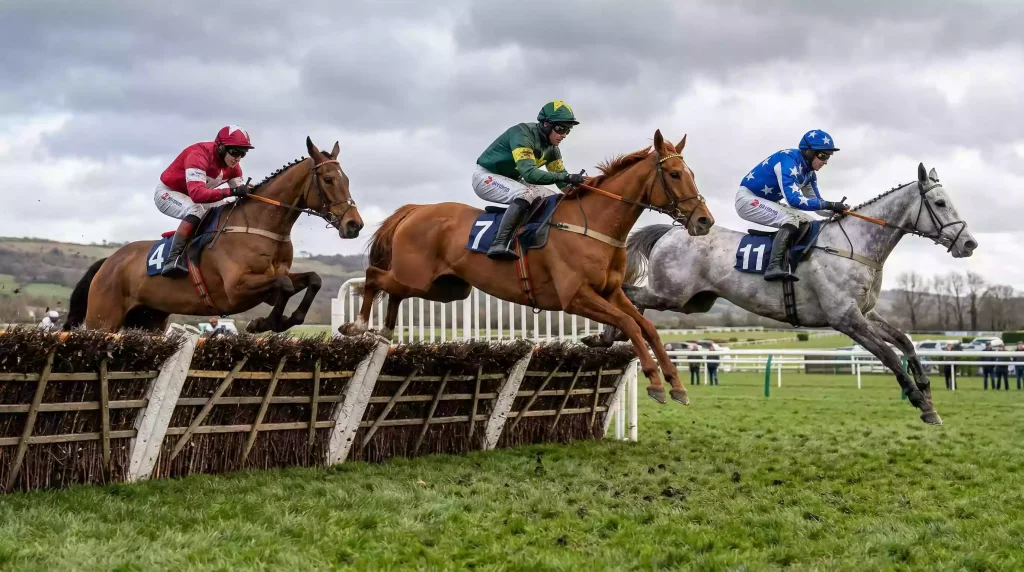
Hurdles are smaller, standing three feet six inches, and have traditionally been built from birch. The ongoing transition to One-Fit Padded Hurdles is the most significant change to jump racing infrastructure in decades. Padded hurdles are designed to reduce the severity of impact when a horse hits the obstacle, lowering the fall rate without fundamentally altering the challenge. The evidence supports the switch: the 11% reduction in fall risk identified by the RVC is a meaningful improvement in a sport that runs approximately 35% of its races over jumps.
The water jump — a low fence followed by a stretch of water — appears on some steeplechase courses but is gradually being phased out at several tracks. National Hunt flat races (bumpers) involve no obstacles at all; they are run on the hurdle course after the hurdles have been removed, and serve as introductory races for young jump horses.
Matching Horse to Course
The central skill in jump racing analysis is matching a horse’s profile to a course’s demands. A slick, accurate jumper with cruising speed is ideally suited to Kempton. A galloping stayer with the constitution to handle heavy ground belongs at Haydock. A horse that stays, jumps accurately, and can handle undulations is a Cheltenham horse. These are not rigid rules — exceptional animals win anywhere — but they are patterns that repeat across seasons and decades. The course tells you what it wants. The form book tells you which horse can provide it.